
Guimarães is the town Portugal calls its cradle, and two days is the right length for it. The historic centre, on UNESCO's World Heritage List since 2001, is small enough to cross on foot in a quarter of an hour, but it holds a 15th-century ducal palace, a 10th-century castle, a Romanesque church where tradition says the first king was baptised, a Gothic collegiate church and a museum with twelve objects classified as national treasures. Add the cable car to Monte da Penha, the highest point of the municipality at 613 metres, and you have a full weekend without needing a car.
This plan is built around the train from Porto and around one rule that catches many visitors: the Paço dos Duques, the castle and the Church of São Miguel all stop admitting people at 17:30. Saturday therefore covers the lower town in the morning and the three monuments on the castle hill in the afternoon. Sunday starts with the cable car, when the mountain is quietest, and ends at the Museu de Alberto Sampaio, which is open on Sundays and closed on Mondays. Walking adds up to about 4 km on Saturday and 3 km on Sunday, on granite paving with one steady climb to the castle hill. Both days work on a Saturday and Sunday in November, with one warning: the cable car's published hours were for October 2026, so check the November timetable before you go up.
Book these before you go
Nothing in Guimarães sells out the way the big Lisbon or Porto sights do, but two things are worth sorting out in advance.
- Paço dos Duques and the castle. Tickets are sold at the door and online through the Paço's ticketing page. In 2026 the Paço costs €10, the castle €5 and a combined Paço + castle ticket €13. Children up to 12 enter free with an adult; ages 13–24, over-65s and families with at least one adult and one child pay half.
- The train from Porto. CP's urban trains to Guimarães leave Porto São Bento roughly every two hours at weekends (timetable below). Buy the ticket from the machines or the ticket office before boarding: CP only sells on board where a station has no machine or office within 200 metres, and fines passengers who board without one elsewhere.
Day 1, 09:39 — Arriving by train: the 08:20 from São Bento
The weekend 08:20 train from Porto São Bento (it also stops at Campanhã at 08:25) reaches Guimarães at 09:39 after 1 hour 19 minutes, calling at every station on the way, including Ermesinde, Trofa, Santo Tirso and Vizela. It runs every day, so the same plan works if you shift it to a Friday or a Monday, although Monday brings the museum closure described on Day 2. The only earlier weekend train leaves São Bento at 07:20; the next after 08:20 is at 10:20, which would push the castle hill to the very end of the afternoon.
Guimarães station sits on Avenida Dom João IV at the southern edge of the centre. If you are staying overnight in the historic centre, leave your bag at your accommodation first; the walk from the station to Largo da Oliveira is about 1 km, roughly 12–15 minutes, mostly on pavement.
Day 1, 09:50 — Centro Cultural Vila Flor: an 18th-century palace garden next to the station
The first stop is barely 200 metres from the station. The Centro Cultural Vila Flor occupies the 18th-century Vila Flor palace and its terraced gardens on Avenida D. Afonso Henriques, with a modern auditorium building added when the complex was converted. It opened in September 2005 and has been the main cultural venue in the town ever since, with two auditoriums for theatre and contemporary dance and a café-concert room for music.
On a weekend morning you come for the outside: the palace front and the gardens of the old estate. Allow 20 minutes. The centre does not publish garden opening hours on its website, so if the gates are closed, look at the palace facade from the avenue and move on. Check its programme at ccvf.pt for a Saturday evening concert or play; it is the obvious way to spend the first night.
From Vila Flor, walk north to Largo do Toural, about 550 metres in a straight line, so roughly 8–10 minutes on foot.
Day 1, 10:15 — Largo do Toural: "Aqui nasceu Portugal" on the old wall
Largo do Toural takes its name from its first use as a cattle fair outside the walls, and locals still treat it, together with Largo da Oliveira and Praça de Santiago, as the centre of town. Beside it runs a surviving stretch of the medieval town wall, and on one of its towers, the Torre da Alfândega, large letters read Aqui nasceu Portugal: "Portugal was born here". The letters are lit at night, which makes this a good spot to return to after dinner.
 The "Aqui nasceu Portugal" lettering on the Torre da Alfândega, part of the medieval town wall, lit up at night. Image: Valdemar Guimarães, CC BY 2.0, via Wikimedia Commons.
The claim rests on the Battle of São Mamede, fought near Guimarães on 24 June 1128, when the young Afonso Henriques defeated the forces of his mother Teresa and took control of the County of Portugal. He later took the title of king. The city still keeps 24 June as its municipal holiday, and on that day the Paço and the castle are closed. Allow 15 minutes here, then walk through the wall into the old town: Largo da Oliveira is about 250 metres away, three or four minutes on foot.
Day 1, 10:35 — Largo da Oliveira and Praça de Santiago: the two squares at the heart of the old town
The medieval squares of Guimarães are the point where everything in the town meets. Largo da Oliveira is the larger of the two, closed on one side by the Igreja de Nossa Senhora da Oliveira, the church of the old collegiate chapter. Its origins lie in the monastery founded by Countess Mumadona Dias in the 10th century, the same foundation the castle was built to protect. The present church owes most to King João I, who paid for its rebuilding from 1387 in fulfilment of a vow to the image of Santa Maria of Guimarães; the work was largely finished by 1401. If no service is under way, step inside; opening hours for visitors are not published, so treat it as a bonus.
 Largo da Oliveira on a summer day, with café terraces under the old balconied houses. Image: Palickap, CC BY-SA 4.0, via Wikimedia Commons.
In front of the church stands the Padrão do Salado, a small open Gothic porch of four pointed arches over a stone cross. King Afonso IV raised it in 1340 to mark the victory at the Battle of Río Salado in Spain, where he fought beside his son-in-law Alfonso XI of Castile against a Muslim army. The cross inside was a gift of a Guimarães merchant, Pero Esteves. Both the porch and the church have been national monuments since 1910.
 The Padrão do Salado, the 14th-century Gothic porch in front of the Igreja de Nossa Senhora da Oliveira. Image: John Samuel, CC BY-SA 4.0, via Wikimedia Commons.
Pass under the arches of the old town hall and you come out in Praça de Santiago, a smaller square lined with tall, narrow houses with wooden balconies and overhanging upper floors. At lunchtime its café terraces fill up first. Allow an hour for both squares, including the church.
 Praça de Santiago, lined with granite-and-timber houses with balconies. Image: CEphoto, Uwe Aranas, CC BY-SA 3.0, via Wikimedia Commons.
Day 1, 11:45 — Lunch in the old town
Eat around Largo da Oliveira, Praça de Santiago or the streets between them; there is no shortage of places, and on a Saturday it is worth sitting down before 13:00. Aim to be walking uphill by 13:15. This is the only meal break in the plan, and the afternoon on the castle hill is long.
Day 1, 13:15 — Rua de Santa Maria: the old street up to the castle hill
Rua de Santa Maria leaves Largo da Oliveira and climbs north towards the castle hill, linking the square of the old monastery-church with the fortress above it. It is narrow, paved in granite and lined with old stone houses. Walk it slowly; it is about 450 metres from Largo da Oliveira to the gate of the Paço in a straight line, so 10 minutes with stops, uphill all the way.
At the top the street opens onto Latito hill: the Paço dos Duques on your right, the castle above it, and the small church of São Miguel between them. All three are national monuments, all three are run by the same state museum service, and all three follow the same hours: daily 10:00–18:00, last admission 17:30.
Day 1, 13:30 — Paço dos Duques de Bragança: a 15th-century palace rebuilt in the 20th
The Paço dos Duques de Bragança is the town's main sight, and it deserves the biggest slot of the weekend. It was built in the 15th century for D. Afonso, 8th Count of Barcelos and later 1st Duke of Bragança, a natural son of King João I. The style, a long brick-and-granite block with corner towers and tall brick chimneys, has more in common with northern European manor houses than with anything else in Portugal.
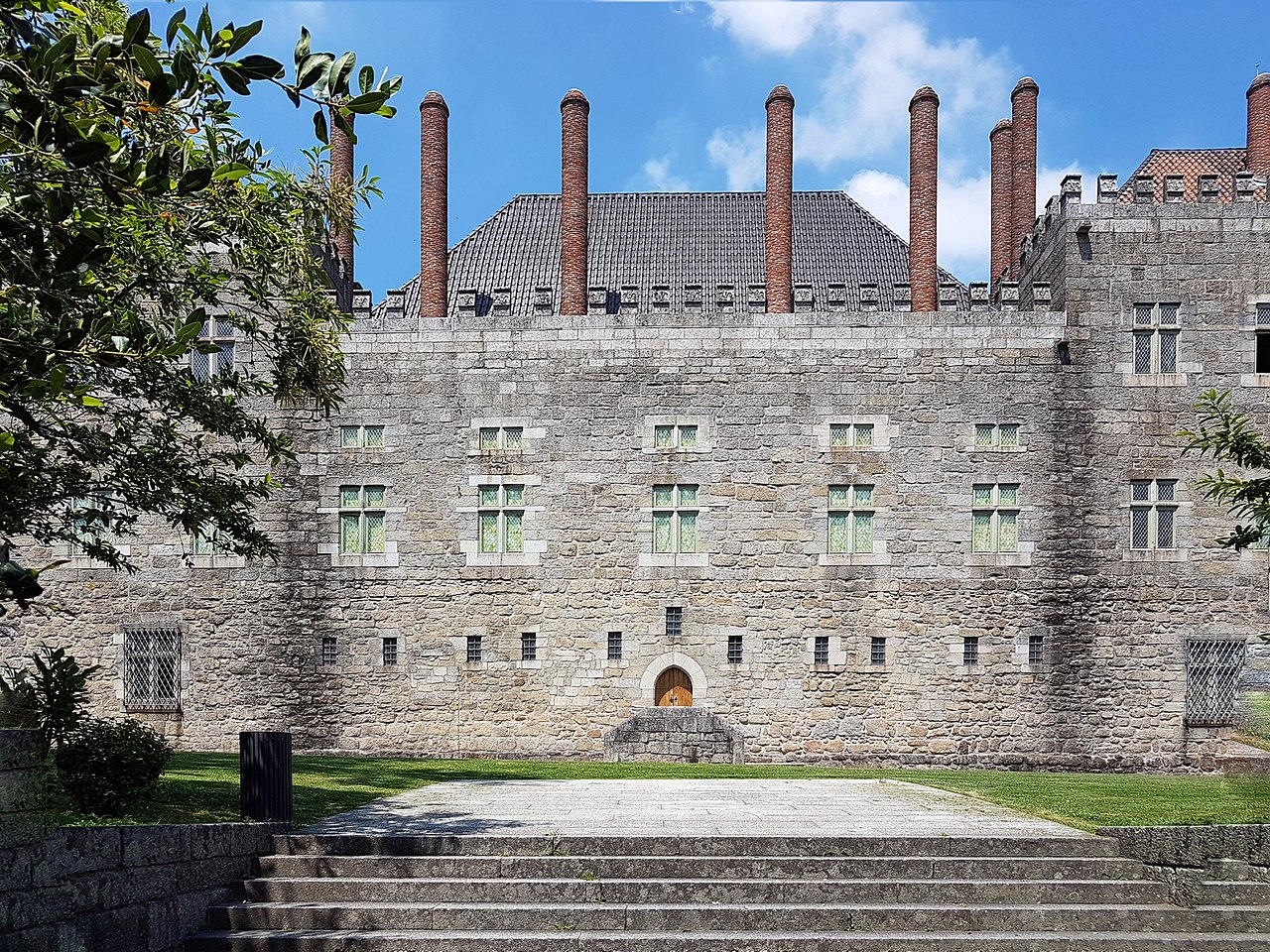 The Paço dos Duques, with its row of tall brick chimneys above the granite walls. Image: xlibber, CC BY 2.0, via Wikimedia Commons.
What you see today is also a 20th-century work. The dukes moved to Vila Viçosa in the Alentejo, the palace fell out of use, its stone was quarried, and from 1807 it served as a barracks. In the 1930s the Estado Novo regime commissioned the architect Rogério de Azevedo to rebuild it, and the result was inaugurated in June 1959. Historians still argue about how much of its grandeur is invented; it is worth knowing that as you walk through.
Inside, the route follows the Salão dos Passos Perdidos, the arms room, the banqueting hall, the chapel and the great hall, plus the bedchambers of D. Afonso and of Catarina de Bragança. The furniture, tapestries, weapons and porcelain mostly come from the 16th and 17th centuries. The top floor was fitted out as an official residence for the President of the Republic. Allow 90 minutes to two hours. The Paço's ticketing page warns that its lift is having technical problems and may not be available, so expect stairs.
Tickets in 2026: Paço €10, or €13 for the Paço plus the castle. The Paço's own price list also gives a three-site ticket that adds the Museu de Alberto Sampaio (Day 2), but the two museums' websites disagree on its price (€17 on the Paço's page, €13 on the museum's), so ask at the desk; at either price it is cheaper than buying all three separately (€20).
Day 1, 15:30 — The statue of Afonso Henriques and the Church of São Miguel do Castelo
Leave the Paço by its main entrance and you walk straight past the statue of Afonso Henriques, the bronze figure in mail with sword and shield. It is the work of the sculptor António Soares dos Reis and was unveiled by King Luís on 20 September 1887. It stood in two other places in the town, including the Toural, before it was moved here in 1940. The sword went missing from photographs for a few months: the city removed it in November 2025 after a part near the hilt disappeared, and it was put back on 20 April 2026.
 Soares dos Reis's statue of Afonso Henriques, with a tower of the castle behind it. Image: CEphoto, Uwe Aranas, CC BY-SA 3.0, via Wikimedia Commons.
A few minutes' walk up the slope stands the Igreja de São Miguel do Castelo, a plain granite Romanesque church. Tradition says Afonso Henriques was baptised in its font. The oldest written mention of the church dates from 1216 and it was consecrated in 1239, while Afonso Henriques lived in the 12th century, so the tradition is hard to square with the building as it stands. The font itself has had a journey: it was taken to the Oliveira church in 1664 and returned in 1927. Many old tomb lids remain inside, and on the outside of the west wall two arched niches are thought to hold the burials of the precentor Martim Pais, who died in 1223, and of João Anes Enxate. The church follows the Paço's hours. Allow 20 minutes for the statue and the church together.
 The west wall of São Miguel do Castelo, with the two arched tomb niches on either side of the door. Image: Krzysztof Golik, CC BY-SA 4.0, via Wikimedia Commons.
Day 1, 16:00 — Castelo de Guimarães: the walls of the fortress, but not the keep
The castle stands about 150 metres north of the Paço, on a granite outcrop at the top of the hill. Countess Mumadona Dias stated in 968 that she had built it to protect the monastery below; a document of 950 does not mention it, which dates its origins fairly closely. Counts Henrique and Teresa reworked it at the end of the 11th century, and the eight towers and the central keep were added under kings Afonso III and Dinis in the late 13th century. It was neglected from the 16th century and later used as a prison, classified as a national monument in 1881, and heavily restored between 1936 and 1940.
 The curtain wall and towers of Guimarães castle, with the keep rising behind. Image: John Samuel, CC BY-SA 4.0, via Wikimedia Commons.
The visit takes in the courtyard and the walls, with views over the Paço's chimneys, the old town and, to the south-east, Monte da Penha, where Day 2 begins. One change matters in 2026: the keep, the tall square tower in the middle, is temporarily closed to the public according to the monument's ticketing page, so do not count on climbing it. Allow 45 minutes. Remember the 17:30 last admission; if the Paço has run long, do the castle first and the church afterwards.
Day 1, 17:30 — Back to the squares: the old town after dark
Walk back down through the park on the castle hill, then down Rua de Santa Maria to Largo da Oliveira, about 10 minutes. On a Saturday evening the two squares fill with residents as much as visitors, and the lit lettering on the Toural is two minutes further on. If you booked something at Vila Flor, it is about 10 minutes' walk from Largo do Toural. If you are not staying overnight, the last weekend trains back to Porto São Bento leave Guimarães at 19:51, 21:51 and 22:55.
Day 2, 10:00 — The cable car to Monte da Penha: under eight minutes and 366 metres up
The Teleférico de Guimarães opened in 1995 and climbs about 1.7 km from the Hortas station, on Rua Aristides de Sousa Mendes at the eastern edge of the historic centre, to the top of Monte da Penha. The ride rises 366 metres and takes a little under eight minutes. It is run by Turipenha, a public-interest tourism cooperative. Walk from Largo da Oliveira to the lower station in about 10 minutes; the distance is roughly 650 metres in a straight line.
 A cabin of the Guimarães cable car above the woods of Monte da Penha, with the town below. Image: Joseolgon, CC BY-SA 4.0, via Wikimedia Commons.
Three things to check before you set off. The operator's published timetable for October 2026 was daily 10:00–17:30, with the ticket office closing 15 minutes before the last trip; check turipenha.pt for November (in November 2025 it ran only Friday to Sunday and on holidays, 10:00–17:15). The service depends on the weather and on scheduled maintenance: on 9 November 2026, for example, it is closed from 10:00 to 14:00. And the line was shut from January 2026 for a major overhaul that was planned to take two months and overran (it was still closed in mid-March), so long closures do happen. Turipenha's published price list gives €5 one way and €10 return for adults, and €3 and €5 for children aged 6–11; buy at the lower station.
If the cable car is not running, Penha is also reached by road (taxi) from the centre. Or swap the two halves of the day: Museu de Alberto Sampaio at 10:00 and the mountain in the afternoon if the weather lifts.
Day 2, 10:15 — Penha: the sanctuary and the granite boulders on the summit
The upper station is less than 100 metres from the Santuário da Penha, a 20th-century granite church on the top of the mountain. Its stepped front, with a tall pointed window and two crosses, faces a long esplanade and a pool. The mountain has been a pilgrimage site since the first organised pilgrimage on 8 September 1893; it is still held every year on the second Sunday of September, the one weekend when the summit is crowded.
 The Penha sanctuary at the top of Monte da Penha, with the esplanade and pool in front. Image: Jorge Lobo, CC BY-SA 4.0, via Wikimedia Commons.
The rest of the summit is woods, paths and large rounded granite boulders. Follow the paths to the edge of the summit: on a clear day you look straight down on the town and the castle hill, the reverse of the view from the castle walls the day before. The paths are uneven and slippery after rain, and the summit is noticeably colder and windier than the town in November, so bring a layer. Allow two hours, then take the cable car back down by about 12:30.
Day 2, 12:45 — Lunch back in the centre
From the Hortas station you are 10 minutes from Largo da Oliveira again, or about the same from Largo do Toural. Eat near the museum; it opens straight off Largo da Oliveira.
Day 2, 14:00 — Museu de Alberto Sampaio: silver, an altarpiece and João I's loudel around a cloister
The Museu de Alberto Sampaio is the one place in town where you see what the collegiate church of Nossa Senhora da Oliveira owned. It was created in 1928 inside the old collegiate buildings beside the church, and its rooms open off a cloister with an olive tree at its centre.
The museum lists twelve objects classified as national treasures. The ones to find: a 12th-century chalice in gilded silver; the Tríptico da Natividade, a gilded silver altarpiece with enamels from the late 14th century; the 14th-century gilded silver and enamel image of Santa Maria de Guimarães; and the Loudel de D. João I, a 14th-century military garment linked to the king who rebuilt the church. Around them are processional crosses, reliquaries, carved and gilded woodwork, sculpture, paintings and fresco fragments.
The museum is open Tuesday to Sunday, 10:00–18:00, and closed on Mondays, Easter Sunday, 1 January, 1 May and 25 December. A standard ticket costs €5 in 2026; the cloister alone is €1, and the same half-price and under-12 rules apply as at the Paço. Allow 75 minutes. On some summer evenings the museum stays open until midnight for its "Museu à Noite" series, but not in November.
If you are not visiting on a weekend: this is the stop that a Monday breaks, which is the main reason this plan runs Saturday–Sunday rather than Sunday–Monday.
Day 2, 15:30 — A last walk, then the train
Use the last hour on whatever you rushed on Saturday: the inside of the Oliveira church, a second look at Praça de Santiago, or the Toural in daylight. Then walk to the station, about 1 km from Largo da Oliveira, 12–15 minutes on foot. Weekend trains to Porto São Bento leave Guimarães at 15:51, 17:56 and 19:51, taking about 1 hour 15 minutes; the 17:56 and 19:51 run only on Saturdays, Sundays and public holidays.
What about Braga?
Braga, with the Baroque staircase and funicular of Bom Jesus do Monte and the Sé de Braga, is close to Guimarães on the map but awkward to combine with it at weekends. The direct regional bus, line 101 via the A11, runs only on weekdays; its timetable says plainly that there is no service on Saturdays, Sundays or holidays. Braga has its own CP urban line from Porto, so it works better as a separate day trip from Porto than as an add-on to this weekend. With a car it becomes a half-day option on Sunday afternoon in place of the museum.
The weekend at a glance
| Time | Stop | Allow | Book ahead? |
|---|---|---|---|
| Sat 08:20 | Train Porto São Bento → Guimarães (arr. 09:39) | 1 h 20 | Ticket before boarding |
| Sat 09:50 | Centro Cultural Vila Flor gardens | 20 min | No |
| Sat 10:15 | Largo do Toural, "Aqui nasceu Portugal" | 15 min | No |
| Sat 10:35 | Largo da Oliveira, Padrão do Salado, Praça de Santiago | 1 h | No |
| Sat 11:45 | Lunch in the old town | 1 h 15 | No |
| Sat 13:15 | Rua de Santa Maria up to the castle hill | 15 min | No |
| Sat 13:30 | Paço dos Duques de Bragança | 1 h 30–2 h | Optional (online) |
| Sat 15:30 | Statue of Afonso Henriques, Church of São Miguel | 20–30 min | No |
| Sat 16:00 | Castelo de Guimarães (keep closed) | 45 min | Optional; last entry 17:30 |
| Sun 10:00 | Cable car to Monte da Penha | 10 min each way | No; check hours |
| Sun 10:15 | Penha sanctuary and summit paths | 2 h | No |
| Sun 12:45 | Lunch | 1 h 15 | No |
| Sun 14:00 | Museu de Alberto Sampaio | 1 h 15 | No |
| Sun 15:51 or 17:56 | Train back to Porto São Bento | 1 h 15 | Ticket before boarding |
Practical notes
Getting there. CP's urban trains on the Guimarães line run from Porto São Bento, via Campanhã, in about 1 hour 15–20 minutes (timetable in force since 14 December 2025). On Saturdays and Sundays, departures from São Bento are at 07:20, 08:20, 10:20, 12:20, 14:20, 16:20, 18:25, 20:20, 21:20 and 23:20. Back from Guimarães: 06:51, 08:51, 09:51, 11:51, 13:51, 15:51, 17:56, 19:51, 21:51 and 22:55. Buy your ticket from the machines or ticket office at the station before boarding.
Getting around. Everything except Penha is on foot. Wear shoes with grip: granite paving is slippery when wet, which in November is often. The climb from Largo da Oliveira to the castle is gentle but continuous.
Tickets. Paço €10, castle €5, Paço + castle €13, Museu de Alberto Sampaio €5 (2026 prices). Children up to 12 are free with an adult at all three; ages 13–24 and over-65s pay half. Portuguese residents can use the Voucher52 scheme for free entry.
Closures. The Paço, castle and São Miguel are open every day, 10:00–18:00, last entry 17:30, and closed on 1 January, Easter Sunday, 1 May, 24 June (the city holiday) and 25 December. The Museu de Alberto Sampaio is closed on Mondays as well as on Easter Sunday, 1 January, 1 May and 25 December. The castle keep is temporarily closed. The cable car ran daily in October 2026 but has run only Friday to Sunday and on holidays in past winters, so check the November timetable; it also stops for bad weather and maintenance, and was closed for several months from January 2026.
The classic mistake. Arriving on a late-morning train, doing the squares and lunch first, and reaching the castle hill after 17:00, when the Paço and the castle have already stopped letting people in. Do the hill in the early afternoon and leave the squares for the evening.
Hours and prices are as published by the operators in November 2026.


