
São Miguel has two famous ends, and one day is enough for only one of them. The east has the island's volcanic heat in use: the crater lake of Lagoa do Fogo, stew cooked in the ground beside Lagoa das Furnas, and two iron-rich thermal baths in Furnas. The west has the postcard: the twin lakes of Sete Cidades seen from the crater rim. Trying both in one day means about three hours in the car and most of your stops in passing.
This plan takes the east as the main day and gives the west as the alternative at the end. The east works better in November, when this was written: Terra Nostra and Poça da Dona Beija are worth the drive even in rain or cloud, while Sete Cidades is mostly a view, and a view is lost if the crater is full of cloud. The loop from Ponta Delgada is about 120 km and roughly two and a half hours of driving: three longer legs of about 27, 46 and 40 minutes, and short hops around Furnas. You need a car or a guided tour; this day is not built around buses. If you are staying longer, the 10-day Azores route splits São Miguel over three days.
Book these before you go.
- Poça da Dona Beija sells tickets only online, at bookings.pocadadonabeija.com. In 2026 an adult ticket costs €12 for entry until 17:30 and €16 from 18:00; children aged 2 to 6 pay €10 or €14, and under-2s go free. Each ticket gives you 1 hour 30 minutes. Tickets cannot be exchanged or refunded. Book a slot between 16:30 and 17:30.
- Parque Terra Nostra sells dated tickets on parqueterranostra.com for €17, which includes the thermal pool and jacuzzis. It is refunded only if the garden closes for safety or bad weather.
- Lagoa do Fogo needs nothing from October to mid-June. From 15 June to 30 September the road is closed to visitors' cars and you use a €5 shuttle instead; see the first stop.
09:00 — Lagoa do Fogo: the crater lake before the cloud comes in
Leave Ponta Delgada by 08:30. The drive to the Lagoa do Fogo viewpoint is about 22 km and 27 minutes, climbing from the south coast past Lagoa to the rim of the Água de Pau volcano. Stop first at the Pico da Barrosa viewpoint, on the way up. The crater rim here is about 949 m high, and on a clear day the viewpoint shows the lake, much of the north coast and part of the south coast. The main Lagoa do Fogo viewpoint is 3 minutes further on.
The lake lies at 575 m in a caldera whose last eruption was in 1563, and it has been a nature reserve since 1982. Allow 45 minutes for both viewpoints. Walking down to the shore is a separate outing, so leave it for a day with more time.
 Lagoa do Fogo under low cloud in late February, seen from the crater rim. Image: The Cosmonaut, CC BY-SA 4.0, via Wikimedia Commons.
In winter you drive straight up. The shuttle operator's rules say the road between Caldeira Velha (Ribeira Grande) and Casa da Água (Lagoa) is restricted only from 15 June to 30 September. During that time it is closed to all vehicles except those of residents, taxis, tour operators, travel agencies and tourist-activity companies. In those months, park at Casa da Água (60 free spaces) or Caldeira Velha (101 free spaces) and ride the hop-on, hop-off shuttle. It runs every day from 09:00 to 19:00 and costs €5, with children under 6 free. Each circuit takes about an hour. Buy tickets at lagoadofogo.pt.
Check the cloud before you leave. The lake is high enough to sit inside cloud while Ponta Delgada is sunny. SpotAzores runs a live webcam at Lagoa do Fogo, and a minute spent on it can save you the climb. If it shows white, drive on to Furnas and try again another morning.
From the viewpoint, Furnas is about 39 km and 46 minutes away.
10:40 — Lagoa das Furnas: the caldeiras where the cozido cooks
Park at the caldeiras on the north shore of Lagoa das Furnas. There is a ticket booth for the area; we could not confirm the 2026 charge, so carry a few euros. The lake sits at 359 m in the western of the two calderas of the Furnas volcano, which last erupted in 1630. On this shore the ground steams through fumaroles and boiling mud, and it is hot enough to cook. Pots of cozido das Furnas, a stew of meats and vegetables, are buried in the warm ground and left for hours "using the internal heat of the Furnas volcano", as the regional tourism board's trail page puts it. Visitors follow fenced paths between the steaming holes.
 The caldeiras on the north shore of Lagoa das Furnas from the air, with the lake behind. Image: The Cosmonaut, CC BY-SA 4.0, via Wikimedia Commons.
 Cooks lifting cozido pots out of the hot ground at the Furnas caldeiras. Image: Schnobby, CC BY-SA 4.0, via Wikimedia Commons.
Allow an hour. Spend 20 minutes among the vents, then walk the flat lakeside track for half an hour and come back. The official circular trail round the lake, PRC06 SMI, is 9.4 km and takes about 3 hours, too long for this day. On the far shore it passes the Chapel of Nossa Senhora das Vitórias, a 19th-century Gothic-style chapel. José do Canto, landowner and botanist, built it as a mausoleum for himself and his wife. It stands on the far shore, on the cobbled road the trail follows round the lake, as does the Mata-Jardim José do Canto garden; budget an extra 45 minutes if you go round to see it.
 The Chapel of Nossa Senhora das Vitórias, José do Canto's mausoleum on the shore of Lagoa das Furnas. Image: José Luís Ávila Silveira/Pedro Noronha e Costa, Public domain, via Wikimedia Commons.
11:55 — Pico do Ferro: Furnas from above
The Pico do Ferro viewpoint is about 9 km and 15 minutes from the caldeiras by road, through the village. It looks down on the lake on one side and the village of Furnas, inside its crater, on the other. That is the clearest way to see that the whole valley is a volcano. Allow 15 to 20 minutes, then drive down to the village (about 11 minutes).
 Furnas village in its crater, seen from the Pico do Ferro viewpoint. Image: JCNazza, CC BY 3.0, via Wikimedia Commons.
12:30 — Furnas village: the Caldeiras das Furnas and a cozido lunch
In the village itself, a second group of hot springs and fumaroles boils inside stone kerbs. This is the Caldeiras das Furnas area: grey and orange pools, steam and a strong smell of sulphur, with paths around the vents. Allow 20 minutes. Do not touch the water; it is boiling.
 Boiling springs in stone surrounds at the Caldeiras das Furnas in the village. Image: The Cosmonaut, CC BY-SA 4.0, via Wikimedia Commons.
Lunch is the natural time for cozido, the stew you saw buried on the lake shore. Several restaurants in the village serve it. It is a large, heavy meal, so book a table in the morning, or the day before, and share a portion if you plan to swim afterwards. Allow an hour.
13:45 — Parque Terra Nostra: a garden with a warm iron pool
Parque Terra Nostra is a 12.5-hectare garden in the middle of Furnas. It began in 1782, when Thomas Hickling, a merchant from Boston, bought the land and built a summer house with an ornamental pond. In 1935 Vasco Bensaude enlarged that pond into today's thermal pool. The water is orange-brown with iron, and the garden's own pages put it at 37–42 °C. Two jacuzzis were added in 2015 and 2016.
 The iron-rich thermal pool at Parque Terra Nostra, with the garden's trees behind it. Image: José Luís Ávila Silveira/Pedro Noronha e Costa, Public domain, via Wikimedia Commons.
Hours and rules (2026). The garden is open every day, holidays included, from 10:30 to 16:30. It is closed only on 25 December, and the last entry is at 16:00. Ticket €17, pool included. There are changing rooms with showers and lockers. You must shower before and after bathing, and you may stay in the pool or jacuzzis for 30 minutes at most. The iron stains light swimwear and can change the colour of hair, nails and nail varnish, so wear a dark swimsuit.
Walk the garden first, while you are dry. It holds more than 2,700 camellias in over 800 varieties; the garden says they start flowering in autumn and bloom for about six months. Then swim for your 30 minutes and leave by about 16:00. Allow 2 hours 15 minutes in all. The pool is a good choice in heavy rain, though the garden paths get muddy.
16:30 — Poça da Dona Beija: a soak after dark
Poça da Dona Beija is 600 m from Terra Nostra, about an 8-minute walk or a 1-minute drive (it has its own car park). It is a set of small stone-edged pools fed by a warm stream at about 39 °C, at the edge of the village. It is open from 08:30 to 23:00. The last entry is at 21:30, and everyone must be out of the pools by 22:30.
 Warm water pouring into one of the stone pools at Poça da Dona Beija. Image: Maria sá Afonso, CC BY-SA 4.0, via Wikimedia Commons.
A 16:30–17:30 slot costs €12 and gives you 90 minutes, until about 18:30, which is after sunset in November. Towels cost €4 to rent and lockers €2, each with a €20 cash deposit, so bring your own towel and some cash. Hot showers run on €1 coins; the cold showers are free. Food is not allowed. You reach the pools only by steps, so there is no step-free access to the water. If there is thunder or lightning, the operator asks bathers to leave the water.
Doing only one pool? Choose Terra Nostra for the garden and a bigger pool by day. Choose Poça da Dona Beija for the evening hours, the lower price before 17:30, and smaller pools along a stream.
From Furnas back to Ponta Delgada is about 42 km and 40 minutes, so you are back by about 19:15. Allow longer after dark in rain.
The west alternative: Sete Cidades in a day
Choose the west instead if the forecast is clear for the west of the island, or if you have already seen Furnas. It is shorter: about 60 km of driving in all.
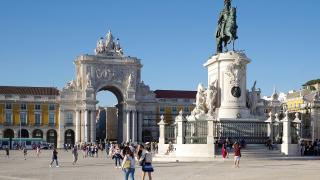
- 09:00, Ponta Delgada. Start at the Portas da Cidade, the three-arched 18th-century city gates. They stood on the old quay and were moved to Praça Gonçalo Velho Cabral when the seafront avenue was built. Allow 20 minutes.
- 09:45, Vista do Rei. The drive is about 20 km and 25 minutes. The Vista do Rei viewpoint is named after King Carlos and Queen Amélia, who came here in 1901. It looks down into a caldera about 6 by 5 km across, at the Lagoa Azul and the Lagoa Verde and the village between them. Local legend says the lakes are the tears of a princess and a shepherd who were kept apart. Allow 30 minutes.
- 10:30, Boca do Inferno. The drive is about 4 km and 5 minutes. Park near Lagoa do Canário and walk roughly 1 km, about 15 minutes each way, to the Boca do Inferno viewpoint. From there you see Lagoa de Santiago, the twin lakes and the sea. Allow 1 hour 15 minutes.
- 12:00, Sete Cidades village. Drive down into the crater (about 10 km, 12 minutes). Have lunch, look at the neo-Gothic church of São Nicolau, and walk onto the bridge where the green and blue lakes meet. Allow 2 hours.
- 14:30, back along the rim. Stop at the Cerrado das Freiras viewpoint, 6 minutes from the village, then return to Ponta Delgada (about 22 km, 26 minutes).
 Lagoa Verde, the bridge and Lagoa Azul from Vista do Rei, with Sete Cidades village on the far shore. Image: JopkeB, CC BY-SA 4.0, via Wikimedia Commons.
 Looking down the Sete Cidades crater towards Lagoa Azul from the Boca do Inferno ridge. Image: José Luís Ávila Silveira/Pedro Noronha e Costa, Public domain, via Wikimedia Commons.
The same webcam rule applies. SpotAzores runs cameras over the Sete Cidades lake and its rim, and if they show cloud, swap this day for the east.
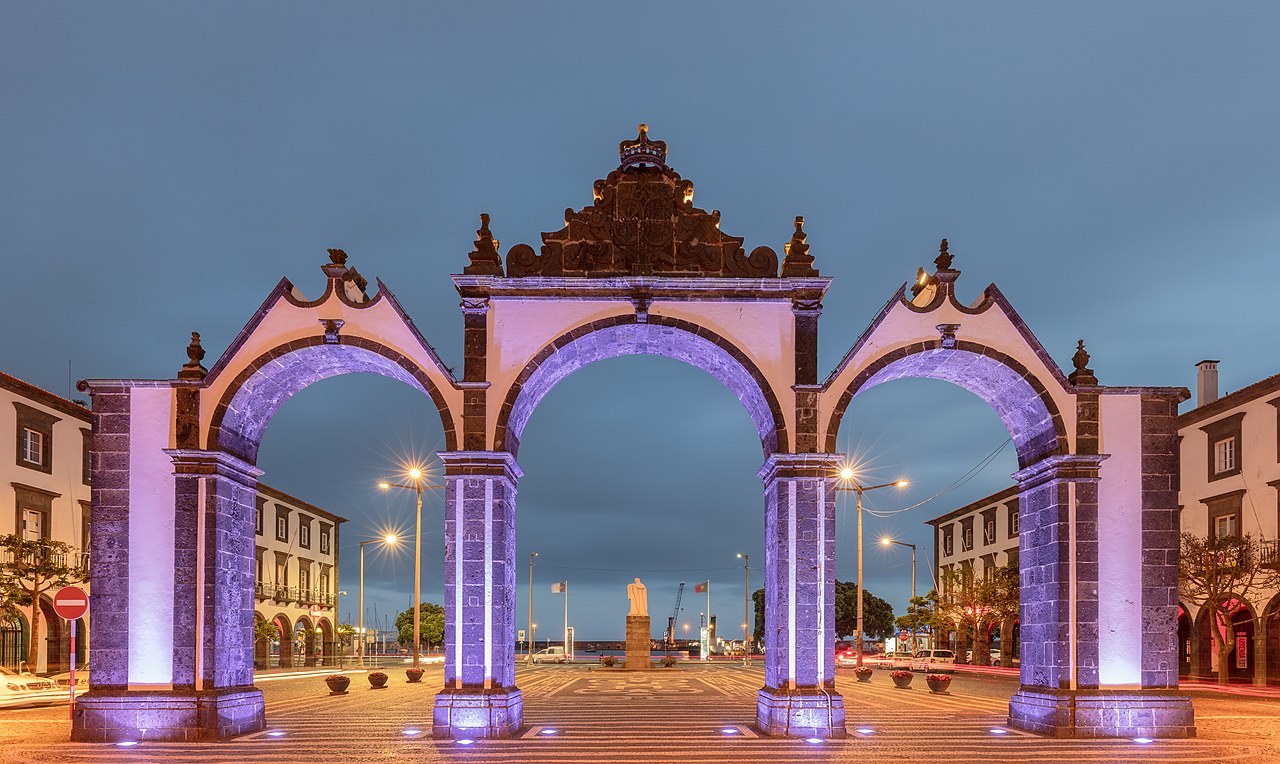 The Portas da Cidade, Ponta Delgada's 18th-century city gates, lit at dusk. Image: Diego Delso, CC BY-SA 4.0, via Wikimedia Commons.
The day at a glance
| Time | Stop | Allow | Book ahead? |
|---|---|---|---|
| 08:30 | Leave Ponta Delgada (27 min drive) | — | Car or tour |
| 09:00 | Pico da Barrosa and Lagoa do Fogo viewpoints | 45 min | No (shuttle €5 from 15 Jun to 30 Sep) |
| 09:50 | Drive to Furnas (46 min) | — | — |
| 10:40 | Lagoa das Furnas caldeiras and lakeshore | 1 h | No (small charge at the booth) |
| 11:55 | Pico do Ferro viewpoint | 20 min | No |
| 12:30 | Caldeiras das Furnas (village) and cozido lunch | 1 h 15 min | Book the table |
| 13:45 | Parque Terra Nostra garden and pool | 2 h 15 min | Dated ticket online, €17 |
| 16:30 | Poça da Dona Beija | 1 h 30 min | Yes, online only, €12 before 17:30 |
| 18:30 | Drive back to Ponta Delgada (40 min) | — | — |
Practical notes
- Getting around. This is a car day. Pick the car up in Ponta Delgada the evening before; the airport is on the edge of the city. The east loop is about 120 km, all on paved roads. The roads to the Lagoa do Fogo rim and to Pico do Ferro are narrow and winding, and fog can come down quickly, so drive with dipped headlights when it does. If you would rather not drive, many operators in Ponta Delgada run full-day Furnas tours that include a cozido lunch. Check whether a tour includes the pools, and which ones.
- Weather. The island's weather changes within the hour, and the high lakes catch cloud first. Look at the webcams before each high stop, not just in the morning. Bring a waterproof, a dark swimsuit and an old towel, and keep a dry change of clothes in the car.
- Holidays. Terra Nostra is open every day except 25 December. Poça da Dona Beija's holiday notice lists 24 and 31 December from 08:30 to 16:00, 25 December closed, and 1 January from 11:00 to 21:30. On those dates a late soak is not possible, so move the pool earlier. Nothing on this route closes on Mondays.
- Summer. From 15 June to 30 September, use the Lagoa do Fogo shuttle from Casa da Água. In summer, book Poça da Dona Beija several days ahead, because evening slots fill first.
- Order matters. Terra Nostra closes at 16:30 and Poça da Dona Beija stays open until 23:00, so do the garden first and the late pool second, never the other way round.
Hours and prices are as published by the operators in November 2026.