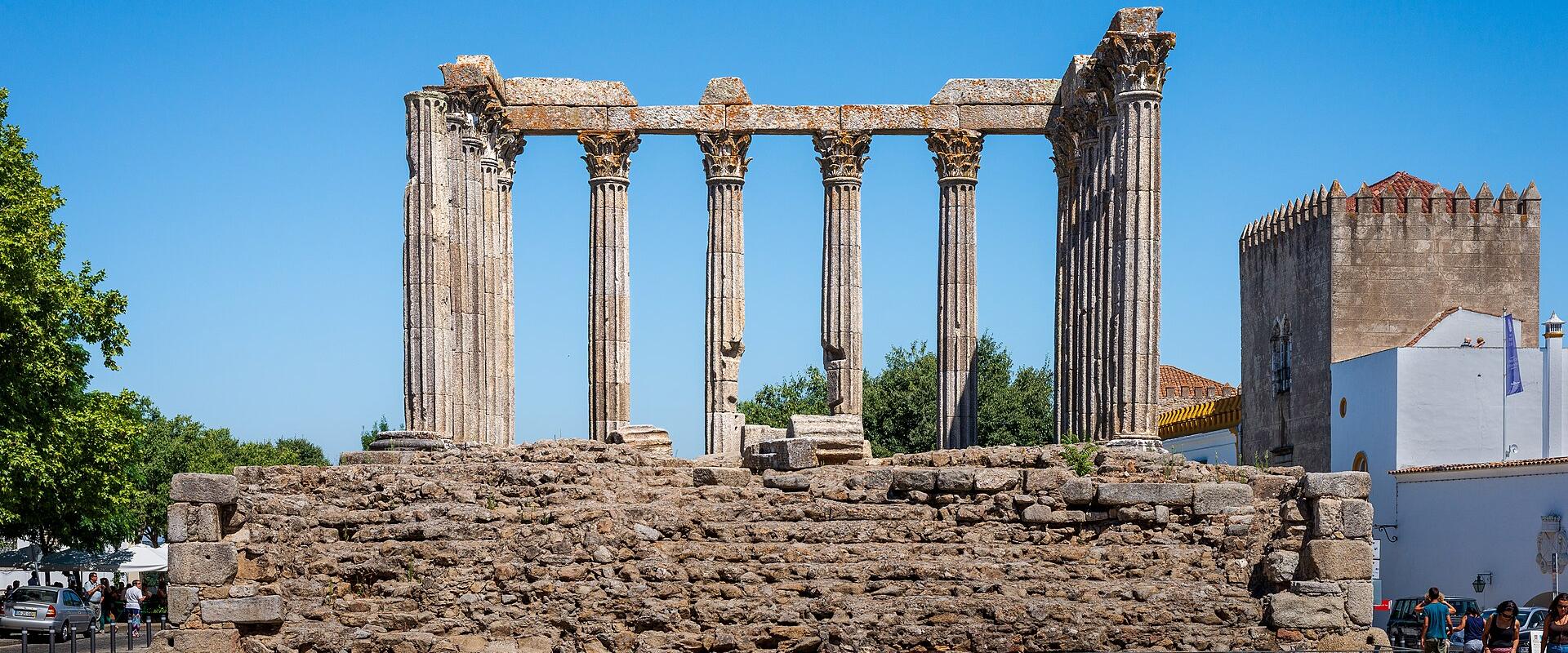
Roman Temple In Évora
1st-century Roman temple in Évora, Portugal
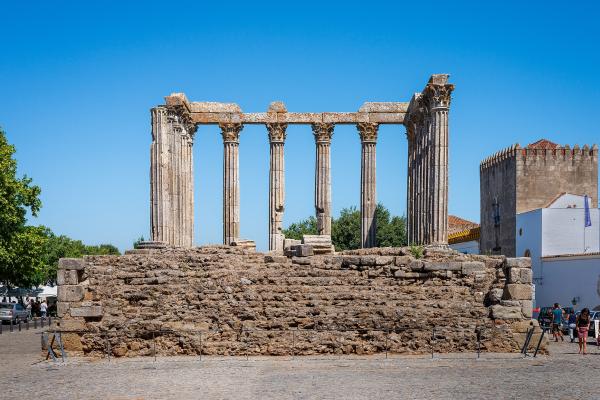
The Roman temple stands on the highest ground of Évora's old town, in a small square beside the Igreja dos Lóios and the old cathedral quarter, and it is the city's best-known monument. A group of tall granite columns topped with carved marble capitals rises from a stepped stone podium, framed by the whitewashed houses and narrow lanes around it. It is one of the best-preserved Roman temples in the Iberian peninsula, and it is a mark of how important the town was in antiquity, when it was known as Ebora Liberalitas Julia.
The temple dates from the 1st century AD, in the early imperial period. The local tradition of calling it the Temple of Diana goes back to a 17th-century story, but there is no real evidence for the dedication. Scholars now believe the temple was probably dedicated to the cult of the emperor Augustus, which was widespread in the Roman provinces and which served to tie local elites to Rome. The building stood at the centre of the Roman forum, with its altar in the open air in front, and it would have dominated the town. It had a deep porch, and the surviving columns are granite shafts with capitals of Estremoz marble in the Corinthian style, a pairing that reflects the use of local materials for the best parts of the building.
The temple survives because it was reused. In the Middle Ages the colonnade was built into a fortification, and later the walls were used by the town for other purposes. In the 19th century, it housed the municipal slaughterhouse. Only in the late 19th century were the later additions removed and the ancient structure restored to view. This long reuse helps to explain why it survived when so many Roman buildings were quarried for stone.
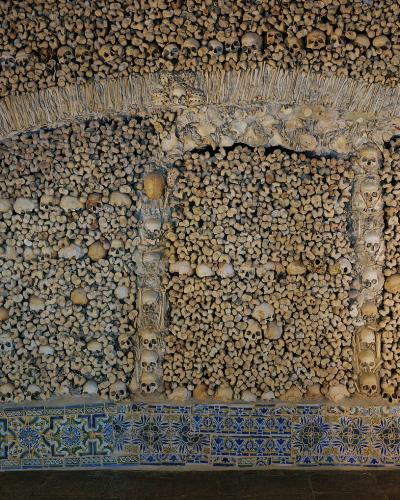
Visiting is easy. The monument stands in an open public space, and you can walk around it at any hour, free of charge, though the structure itself is fenced off at the base. The best times are early morning, when the light is soft and the crowds are thin, and at sunset, when the granite glows. At night, it is lit. The nearby buildings add to the experience: the Pousada dos Lóios, a former convent, the Museu de Évora, and the cathedral, with its cloister and rooftop terrace, are all within a few minutes' walk. The Igreja de São Francisco and its Chapel of Bones, a chamber lined with human skulls and bones, is across the old town and can be added to the same day's tour.
Évora's historic centre was listed by UNESCO in 1986, and the temple is its most photographed monument. It suits history lovers, architecture enthusiasts and anyone on a day trip from Lisbon. Allow half an hour for the temple itself and more if you want to explore the surrounding streets. Summer afternoons are very hot, so plan your visit for the cooler parts of the day.
Categories
More photos coming soon
Hours & Fees
Hours
Open 24 hours a day, 7 days a week
Admission
Free admission
Nearby Attractions
Other places to visit in Évora
Frequently Asked Questions
Quick Facts
Best Time to Visit
Spring (March-May) and autumn (September-October) offer mild weather, lush countryside, and ideal conditions for exploring Évora’s historic sites and surroundings.