Why Évora
Évora is the main city of the Alentejo, about 130 km east of Lisbon, and its walled historic centre was inscribed as a UNESCO World Heritage Site in 1986. The Romans took the town in 57 BC and gave it walls and public buildings; it later became a favoured residence of Portuguese kings, and the Jesuits founded a university here in 1559. The centre is compact enough to see on foot in a day, though an overnight stay allows time for the megalithic sites outside the walls.
The Roman Temple
The Roman temple in the upper part of town is often called the Temple of Diana, but that name is a later misattribution; it is generally thought to have been dedicated to the cult of the Emperor Augustus. It dates from around the 1st century AD, and its granite columns are topped with Corinthian capitals carved in marble from Estremoz. It survived largely because it was walled in and reused for other purposes over the centuries before being restored. The temple stands in an open square and can be seen at any time without a ticket. Next to it, the gardens of the Diana viewpoint look out over the plains.
The Cathedral and Its Roof
Évora's cathedral, the Sé, was built mainly between 1280 and 1340 and has a fortress-like façade with two unequal towers. Inside, the portal statues of the apostles date from around 1335, and the Renaissance choir stalls and organ from the 1560s. The ticketed visit can include the Gothic cloister, the museum of sacred art and the roof terraces, which give the best view over the town's white houses and tiled roofs.
The Chapel of Bones
The Capela dos Ossos is part of the Church of São Francisco, built in the late 15th and early 16th centuries in a mix of Gothic and Manueline styles. The chapel's walls and pillars are lined with human bones and skulls, a Franciscan reflection on mortality. The inscription over the entrance reads "Nós ossos que aqui estamos pelos vossos esperamos" ("We bones that are here await yours"). It is a ticketed visit and usually busy around midday.
Squares, Streets and the Aqueduct
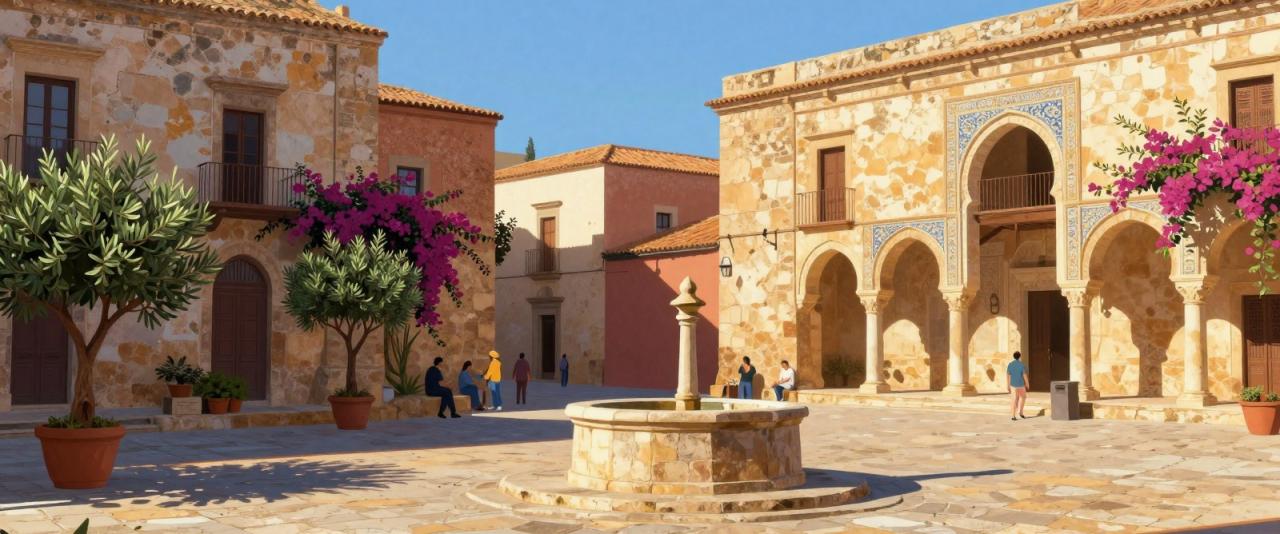
Praça do Giraldo is the central square, with arcaded buildings and a marble fountain from 1570. Autos-da-fé of the Inquisition were once held here. From the square, narrow streets lead up to the cathedral and temple and down towards the walls.
The Água de Prata Aqueduct was built between 1531 and 1537 under King João III to bring water into the city from about 9 km away. Inside the walls, along Rua do Cano, houses have been built into its arches, which is one of the more unusual sights in town. Remains of Roman baths and city walls can also be seen in parts of the centre.
Outside the Walls: The Megaliths
The countryside around Évora has some of the densest concentrations of megalithic monuments in Europe. The Almendres Cromlech, about 15 km west of the city, is a large group of standing stones in a cork-oak landscape, and is generally regarded as one of the most important megalithic sites on the Iberian Peninsula. The final stretch is an unpaved track, so a car or an organised tour is the practical way to get there. Combine it with the Anta Grande do Zambujeiro, a large dolmen in the same area.
Food and Practicalities
Évora is a good place to try Alentejo cooking: açorda (a bread and garlic soup), migas, black pork (porco preto) and the egg-and-cinnamon dessert sericaia. Alentejo red wines are served everywhere.
Trains run from Lisbon to Évora in about an hour and a half, and Rede Expressos buses also cover the route. The historic centre is best explored on foot; parking is easier outside the walls. Summers in the Alentejo are very hot, often well above 35°C in July and August, so plan outdoor sightseeing for the morning and evening.
A practical order for one day is to arrive in the morning, see the cathedral and its roof first while it is cool, walk to the Roman temple next door, then continue down through the streets to Praça do Giraldo. After lunch, visit the Chapel of Bones once the midday groups have thinned out, and finish with a walk along Rua do Cano and the aqueduct arches. Spring and autumn are the most comfortable seasons, and the plains around the city are green from late winter into April.