The Nine Islands in Three Groups
The Azores are an autonomous region of Portugal: nine volcanic islands in the Atlantic, roughly 1,400 km west of Lisbon. They fall into three groups, and the distances between groups shape any island-hopping plan:
- Eastern group: São Miguel, the largest and most visited island, and Santa Maria.
- Central group: Terceira, Graciosa, São Jorge, Pico and Faial. Pico, Faial and São Jorge, the "triangle", sit close together.
- Western group: Flores and tiny Corvo, the most remote islands.
Most international flights arrive at Ponta Delgada on São Miguel, with some routes to Lajes on Terceira and to Horta on Faial. Starting on São Miguel and moving west is the usual pattern.
Getting Between Islands
Flights. SATA Air Açores, the regional airline, links all nine islands with small turboprop aircraft. Flights between groups are short, generally under an hour, but frequencies to the smaller islands are limited, and flights are sometimes delayed or cancelled by wind and fog. Leave slack in your itinerary, especially before an international departure.
Ferries. Atlânticoline runs the inter-island ferries. Year-round, boats connect the triangle islands of Faial, Pico and São Jorge, and in the west Flores and Corvo. In summer, roughly June to September, routes extend to Terceira and Graciosa. The Faial-Pico crossing between Horta and Madalena takes about half an hour. There is currently no ferry between São Miguel and the central group, so that leg has to be flown. Check the current timetable at atlanticoline.pt before planning, since routes change by season.
Sample Routes
- One week: São Miguel (4 nights) and either Terceira or a Faial-Pico pairing (3 nights).
- Ten days to two weeks: São Miguel, then fly to Faial or Pico, cross by ferry between Faial, Pico and São Jorge, and finish on Terceira.
- Two weeks or more: Add Flores for its waterfalls and cliffs, flying via Faial or Terceira. Corvo can be visited as a day trip by boat from Flores in suitable weather.
Moving every night or two wastes time on transfers. Three or four nights per island is a better pace.
Island Highlights
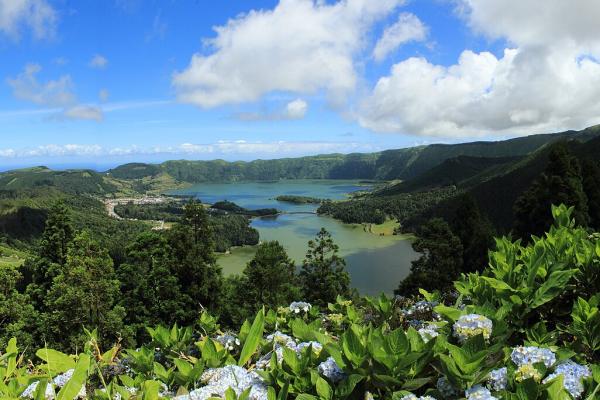
São Miguel has the most variety. Sete Cidades in the west is a large volcanic crater containing twin lakes, one greener and one bluer, best seen from the Vista do Rei viewpoint or by walking the crater rim. Lagoa do Fogo is a crater lake in the middle of the island; in high season (1 August to 30 September in 2026) the access road is closed to private cars during the day and a shuttle runs from nearby car parks. Furnas has hot springs, fumaroles and cozido, a stew cooked in the volcanic ground. On the north coast, the island grows Europe's only commercial tea, which can be seen at the Gorreana plantation.
Pico is dominated by Mount Pico, at 2,351 m Portugal's highest mountain. Climbers must register at the Casa da Montanha, carry the GPS tracker issued there and pay an access fee; daily numbers are capped and summer slots fill early. The climb is long and steep and weather changes fast. The island's lava-field vineyards are a UNESCO World Heritage Site.
Faial has the marina town of Horta, a traditional stop for yachts crossing the Atlantic, and the Capelinhos volcano, which erupted in 1957-58 and extended the island's coast.
São Jorge is a long, narrow ridge with fajãs, flat strips of land at the foot of its cliffs, reached by steep trails. It is known for its cheese.
Terceira has Angra do Heroísmo, a UNESCO-listed historic town, and lava caves such as Algar do Carvão.
Flores has dense waterfalls and cliffs and some of the archipelago's most dramatic walking.
Whale Watching and the Sea
Whale and dolphin watching operates from several islands, mainly Pico, Faial and São Miguel, using traditional land-based lookouts (vigias) to guide boats. Sperm whales are seen year-round, and migrating baleen whales pass mainly in spring.
Practical Tips
- Rent a car on each island you stay on; public buses are infrequent outside the main towns.
- Plan for weather. Conditions can change within an hour, and summits are often in cloud. Check webcams before driving up to viewpoints.
- Use marked trails. The Azores have an official network of signposted walking trails. Check trail status before setting out, as some close after storms.
- Book summer early. Flights, cars and accommodation on the smaller islands are limited in July and August.