
This day covers the far north-western corner of Portugal, where the Minho river meets the Atlantic and the far bank is Spain. It starts on Praia de Moledo, a long Blue Flag beach with a 17th-century island fort offshore, follows the coast north through the pine woods of the Mata do Camarido to the mouth of the Minho, and ends in the walled town of Caminha: a Renaissance fountain, a gate tower with a clock, a late-Gothic parish church and the riverfront at sunset.
The order follows the trains and the light. The Linha do Minho stops at both Moledo do Minho and Caminha, so you can arrive at one end, walk to the other and take the train home without doubling back. The beach and the river mouth come first, while the tide and the light are on the sea side, and the town comes last, when a November day is already short: the sun sets at about 17:30 at the start of the month and about 17:05 at the end. Altogether you walk about 8 km, almost all of it flat, on sand, forest paths and the cobbles of the old town. No ticket needs to be booked in advance.
10:40 — Moledo do Minho: off the train and onto the sand
The InterRegional train that leaves Porto Campanhã at 08:50 (IR 831, daily) reaches Moledo do Minho at 10:37 and runs on to Caminha four minutes later. Get off at Moledo. The halt is about 500 m from the beach, about 7 minutes on foot. If you are driving, the A28 motorway from Porto has an exit for Moledo and Vila Praia de Âncora. Park in Moledo, and come back for the car by train or taxi at the end of the day (see the practical notes).
10:45 — Praia de Moledo: a Blue Flag beach and a fort on the horizon
Praia de Moledo is a wide beach of white sand broken by rocks, and it is on the Blue Flag list for 2026, one of four Blue Flag beaches in the municipality of Caminha. The municipality lists it as good for surfing, bodyboarding and windsurfing, which gives you an idea of the sea: this is the open Atlantic, cold even in summer, and with real waves.
To the north is the rocky islet of Ínsua with its fort, and behind it, across the river mouth, the steep cone of Monte de Santa Tecla above the Galician town of A Guarda. In November the beach is outside its bathing season. There are no lifeguards, so this is a walk, not a swim. Allow about an hour to walk north along the sand at an easy pace.
If it rains: the beach is exposed and there is little shelter. Skip the long walk, take the regional train that leaves Moledo do Minho at 12:05 (daily) to Caminha (12:11), and start the town part of the day early.
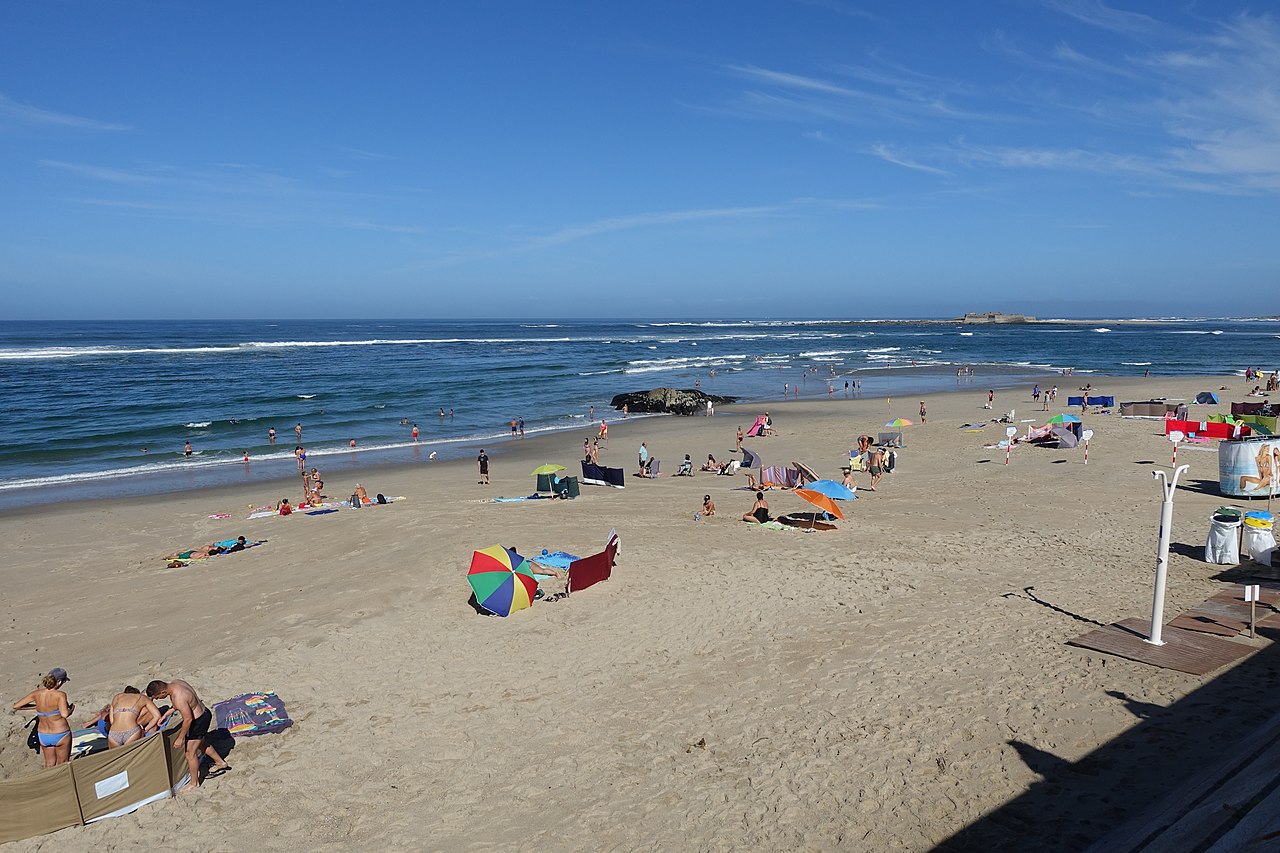 Praia de Moledo on a summer day, with the Ínsua islet on the horizon. Image: Joseolgon, CC BY-SA 4.0, via Wikimedia Commons.
11:45 — Forte da Ínsua: the island fort, seen from the shore
The fort on the islet is the Forte da Ínsua, and the best view of it is from the northern end of Moledo beach, where it sits a few hundred metres offshore. Its history begins in 1392, when Franciscan friars from Galicia founded a small convent on the islet. What you see today is the star-shaped fort with five bastions and a ravelin built between 1649 and 1652, during the war that followed Portugal's break with Spain in 1640. The Franciscan convent stands inside its walls, and was enlarged in 1676. The site has been a National Monument since 1910. The municipality's heritage text also points out its curiosity: a freshwater well on an island in the sea.
You cannot simply walk or swim across. The islet is reached only by boat. In 2019 the state put the fort out to tender under the Revive programme, which leases unused heritage buildings to private operators for tourism, with a 50-year concession. In November you should plan to see it from the beach. Guided boat visits have been advertised in past summers, but we could not confirm any landing in November 2026. If a landing matters to you, ask at the Caminha tourist office before you travel.
 The Forte da Ínsua on its islet off Moledo, seen across the water from the shore. Image: Joseolgon, CC BY-SA 4.0, via Wikimedia Commons.
12:15 — Mata do Camarido and Praia da Foz do Minho: pines to the river mouth
Walk on north along the shore or the paths behind the dunes into the Mata Nacional do Camarido, the coastal pine forest that runs along the last stretch of the Minho. Beyond it is the Praia da Foz do Minho, which the municipality describes as Portugal's northernmost sea beach: about 1.2 km of sand on the south bank of the river mouth, with Spain on the far side.
Two short official paths run here. The Ecovia de Cristelo (1,500 m) runs through the pines between Moledo and Caminha. The Ecovia da Praia da Foz do Minho (1,020 m) follows the estuary from the EN13 road to the river beach at the mouth. From the northern end of Moledo beach to Caminha's main square is about 3.7 km, or roughly 50 minutes of walking, with stops on top of that. Plan to arrive in Caminha around 13:30.
 A boardwalk through the pines of the Mata do Camarido. Image: Krzysztof Golik, CC BY-SA 4.0, via Wikimedia Commons.
Here the river is the border: A Guarda and Monte de Santa Tecla are across the water. There is no bridge at the mouth. The nearest road crossing is upriver, between Vila Nova de Cerveira and Goián.
 The Minho estuary seen from Monte de Santa Tecla in Galicia, looking across to the Camarido pines and the Portuguese bank. Image: José Mouteira, CC BY-SA 3.0 es, via Wikimedia Commons.
Shortcut: if the weather turns or your legs do, the halt at Senhora da Agonia, between Moledo and Caminha, is the access point that CP gives for both ecovias. Only regional (R) trains stop there, so check the times first.
13:30 — Lunch in Caminha
Caminha's old town has cafés and restaurants around the main square and the streets just off it. Out of season, opening days can be shorter, so do not count on one particular address. The Minho is known for its river and sea fish and for vinho verde. Allow an hour.
14:30 — Praça Conselheiro Silva Torres: the fountain of 1551
The main square of Caminha, Praça Conselheiro Silva Torres, which locals call the Terreiro, began as the open ground where seasonal markets and town meetings were held. Over time the council turned it into the town centre, and the Paços do Concelho, the Misericórdia hospital and a public fountain were built around it.
The fountain, the Chafariz, was built between 1551 and 1553 by João Lopes o Velho, a master mason from Viana do Castelo who built similar fountains in Porto and Pontevedra. Before it existed, the townspeople had to go outside the walls for water. Look at the masks on the first basin. The municipality's heritage text reads them as seafarers, some bearded and wearing navigators' hats, and possibly as the peoples of the "parts of the world" that Portuguese sailors had reached. The fountain was moved to its present spot in the 19th century, after the liberal wars, when the pillory that stood in the square was demolished.
 The Renaissance fountain on Praça Conselheiro Silva Torres, with the Torre do Relógio behind it. Image: Krzysztof Golik, CC BY-SA 4.0, via Wikimedia Commons.
The Loja Interativa de Turismo, Caminha's tourist office, is on the same square. It is open Monday to Saturday, 09:30–13:00 and 14:00–17:30, and is the place to ask about the Torre do Relógio's opening hours and any boats to the Ínsua. Allow 30 minutes for the square.
15:00 — Torre do Relógio and Rua Direita: through the old Porta de Viana
The Torre do Relógio is the one tower of Caminha's medieval walls that survives intact. The walls were built in the 13th century on the orders of King Afonso III. The gate under this tower, facing south, was the Porta de Viana, the main entrance to the town and the start of the road to Viana do Castelo. Over the arch are an image of Nossa Senhora da Conceição, placed there by King João IV, and the Portuguese royal arms. The clock that gave the tower its name was installed at the top in 1673. The tower has been a National Monument since 1951.
After restoration by the municipality and the national heritage institute, the tower reopened in November 2008 as the Núcleo Museológico do Centro Histórico, a small display on the town's history and growth. We could not confirm its 2026 opening hours, so ask at the tourist office first. If it is closed, the gate and the arms are on the outside and free to see.
 The Torre do Relógio, Caminha's surviving medieval gate tower. Image: Krzysztof Golik, CC BY-SA 4.0, via Wikimedia Commons.
Walk through the arch and along Rua Direita, the old Rua do Meio. Caminha was laid out as a planned town, with three parallel streets on the long axis and three cross streets. Rua Direita divided it in two, running from the Porta de Viana to the back of the parish church. Look for the 16th-century Igreja da Misericórdia and its Renaissance doorway at number 122. It is about 400 m, roughly 5 minutes, from the square to the church at the far end. Allow 30–45 minutes for this stretch.
 Rua Direita, the paved main street of Caminha's walled town. Image: Krzysztof Golik, CC BY-SA 4.0, via Wikimedia Commons.
15:45 — Igreja Matriz: a church built for a seafaring town
The parish church, the Igreja Matriz (also called Nossa Senhora da Assunção), was begun in 1488 under two Biscayan master builders, Tomé de Tolosa and Francisco Fial. The municipality's heritage text calls it one of the most important works of late Portuguese Gothic, paid for by the wealth of what was then a seafaring town. Walk around the outside first. The south portal faced the town and served its people, while the main door opened almost straight onto a stretch of the wall. Above the lateral door, niches hold statues in a style already close to the Renaissance.
Inside, three naves sit under a carved wooden ceiling of strong Mudéjar influence, the work of a Galician carpenter from Tui. A section of the ceiling from the old choir was later reused in the Salão Nobre of the town hall. The Capela dos Mareantes, dated 1511 and paid for by the town's confraternity of seafarers, is considered a turning point between the Manueline style and the Renaissance. The church has been a National Monument since 1910.
We found no published visiting hours for the church. Go in if the door is open, and keep quiet during services. If it is closed, the exterior and the south portal are reason enough for the walk. Allow 45 minutes.
 The east end of Caminha's Igreja Matriz, with its carved parapet. Image: Krzysztof Golik, CC BY-SA 4.0, via Wikimedia Commons.
16:30 — The Minho riverfront: Spain at sunset, and the ferry that is not coming back
Finish on the riverfront below the old town, looking across the Minho to A Guarda and Monte de Santa Tecla. In November the sun sets at about 17:30 at the start of the month and just after 17:00 at the end, so this is the last hour of good light.
Many guides still say you can cross to Spain here on the car ferry. You cannot. The municipal ferry Santa Rita de Cássia has been out of service for years: first because of the Covid border closures, then because of the Spanish pontoon and then because the river had silted up. In July 2025 it was towed to a shipyard in A Guarda for inspection. In October 2026 the Câmara de Caminha put it up for public auction as a vessel at the end of its life, with bids due by 27 October. A Guarda's own tourist office also lists the crossing as suspended. Private boats advertise passenger crossings to Camposancos, on the A Guarda side, with online booking. Check their winter timetable directly; we could not confirm one for November 2026.
 The Minho at Caminha, looking across the estuary to Monte de Santa Tecla. Image: Alexkom000, CC BY 4.0, via Wikimedia Commons.
Caminha station is under 1 km from the square, about 10–12 minutes on foot, for the 18:36 train to Porto, or the 20:49 if you stay for dinner.
Alternative afternoon by car: Monte de Santa Tecla in Spain
With a car you can swap the riverfront and the church for the hill you have been looking at all day. Monte de Santa Tecla (Santa Trega in Galician) above A Guarda has a hillfort, the castro, whose peak of occupation the Galician regional government dates to between the 1st century BC and the 2nd century AD. It also has the Museo Arqueolóxico de Santa Trega (MASAT), founded in 1917, and a view over the river mouth.
Without the ferry, the drive from Caminha goes upriver over the bridge between Vila Nova de Cerveira and Goián: about 30 km and 35–40 minutes each way. Driving up the hill costs €3 per car plus a charge per passenger. The museum costs €1.50 and opens Tuesday to Sunday, 11:00–17:00, in winter. It is closed on Mondays and from January until 15 February.
Watch the clock: Galicia is on Spanish time, one hour ahead of Portugal. A museum that closes at 17:00 in A Guarda closes at 16:00 by your Portuguese watch. Leave Caminha right after lunch.
 Stone house foundations of the castro on Monte de Santa Tecla. Image: Calaboso, CC BY-SA 4.0, via Wikimedia Commons.
The day at a glance
| Time | Stop | Allow | Book ahead? |
|---|---|---|---|
| 10:37 | Arrive Moledo do Minho (IR 831 from Porto 08:50) | — | No, buy on the day |
| 10:45 | Praia de Moledo | 1 h | No |
| 11:45 | Forte da Ínsua, seen from the north end of the beach | 30 min | No (no landing confirmed in November) |
| 12:15 | Mata do Camarido, Praia da Foz do Minho, walk to Caminha | 1 h 15 min | No |
| 13:30 | Lunch in Caminha | 1 h | No |
| 14:30 | Praça Conselheiro Silva Torres and the Chafariz | 30 min | No |
| 15:00 | Torre do Relógio and Rua Direita | 45 min | No |
| 15:45 | Igreja Matriz | 45 min | No |
| 16:30 | Minho riverfront at sunset | 1 h | No |
| 18:36 | Train back to Porto (IR 830, arrives 20:14) | — | No |
Practical notes
Getting there by train. The CP Linha do Minho timetable in force since 14 December 2025 has InterRegional trains from Porto Campanhã that stop at both Moledo do Minho and Caminha. The 08:50 (arrives Moledo 10:37) and the 13:10 (arrives Moledo 14:41) both run daily. Return trains from Caminha leave at 14:46, 18:36 and 20:49, also daily, reaching Porto Campanhã at 16:20, 20:14 and 22:30. Moledo to Caminha takes 4–5 minutes. Check cp.pt for timetable changes before you travel.
By car. Take the A28 from Porto, with exits for Moledo/Vila Praia de Âncora and for Caminha/Vilar de Mouros. If you parked in Moledo, the drive back from Caminha is about 5 km. There are taxi ranks on Praça Conselheiro Silva Torres in Caminha and at the Largo da Estação in Moledo.
November and winter. The beach is outside its bathing season: there are no lifeguards, and most beach bars are closed. Wind and rain come in straight off the Atlantic, so bring a waterproof. The forest paths and the cobbles of the old town are slippery when wet.
Mondays, Sundays and holidays. Everything on the main route is outdoors or a church, so Mondays are fine. The tourist office is closed on Sundays, and the MASAT on Monte de Santa Tecla is closed on Mondays.
Hours and prices are as published by CP, the Câmara Municipal de Caminha and the Xunta de Galicia in November 2026.


