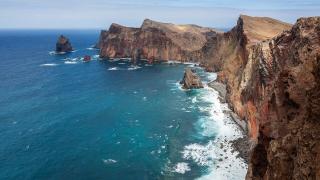

This day covers the southern edge of the Peneda-Gerês National Park, in the municipality of Arcos de Valdevez: the park gate at Mezio, the granite village of Soajo with its pillory and its 24 stone granaries, a two-hour marked walk on the old paved paths above the village, and the castle and granaries of Lindoso, 15 km further east in the municipality of Ponte da Barca. The stops are close together, but nothing links them by public transport, so the day assumes a car.
The order follows the road and the opening hours. Porta do Mezio sits on the EM 202 between Arcos de Valdevez and Soajo, so it comes first, at its 09:30 opening. Soajo's interpretation centre opens at the same time and closes for lunch, so it fits mid-morning, before the granaries. The walk goes after an early lunch, and Lindoso closes the day because the road back to Ponte da Barca and Braga runs past it. Driving between the stops adds up to about 25 km; the walking is about 5–6 km, most of it on the PR 7 loop, with a 300 m climb. In November the sun sets at about 17:25 at the start of the month and about 17:05 at the end, so the day ends at Lindoso by late afternoon.
Before you go
- Monday is the wrong day: Porta do Mezio closes on Mondays from 16 September to 14 June, and Soajo's interpretation centre is open Tuesday to Saturday only. On a Sunday, only the centre is shut.
- Lindoso castle does not publish its opening hours online. Phone the Porta de Lindoso before you set off: 258 578 141 or 962 162 932.
- Nothing needs booking. The only tickets of the day are Porta do Mezio (€3) and Lindoso castle (€1.02 in the municipality's 2026 fee table). Carry some cash for both.
09:30 — Porta do Mezio: the park gate on the road in
Porta do Mezio is one of the five "gates" of the Peneda-Gerês National Park, an 11-hectare visitor area. From October to March it opens 09:30–13:00 and 14:00–17:00. It closes on 24, 25 and 31 December and 1 January, and on Mondays between 16 September and 14 June. Entry costs €3 and covers the whole site; children up to 2 go free. The site holds the park's information point for the Soajo and Peneda mountains, picnic areas, a children's play area, a bird observatory and a rope adventure park. It also holds Starlight "Stellar Park" certification for stargazing.
Use the first 30 minutes for practical things: ask about trail conditions and fog on the mountain, pick up a map, and check whether anything is closed. If you want to stretch your legs before the main walk, the PR 4 Trilho Interpretativo do Mezio starts here. It is a 2.3 km loop, rated very easy, with 83 m of climbing; the municipality allows 45 minutes for it.
 The landscaped central area of Porta do Mezio, with the mountains behind. Image: JoanaDSB, CC BY-SA 4.0, via Wikimedia Commons.
Along the EM 202 near the gate are the prehistoric burial mounds and dolmens of the Mezio megalithic group, one of them right beside the road. A stop of 10 minutes is enough for the nearest one.
 A dolmen of the Mezio megalithic group, on its mound beside the EM 202. Image: AJSL48, CC BY-SA 4.0, via Wikimedia Commons.
Allow 45 minutes in all. From the gate to Soajo is 7 km, about 10 minutes by car. Park at the edge of the village, not in the narrow lanes around the square.
10:30 — Largo do Eiró: Soajo's pillory and its smiling face
Soajo's main square, the Largo do Eiró, is paved with granite slabs and lined with granite houses. In the middle stands the pillory (pelourinho), in front of the old town hall, the Paços do Concelho; the parish church stands close by. Soajo was raised to the status of a vila by King Manuel I on 7 October 1514. Parish records from 1758 show it still had its own council (câmara) and judge. The pillory was the symbol of that local jurisdiction. It has been a National Monument since 1910.
Look at the top of the shaft. Instead of the usual iron fittings or carved capital, there is a round face with large eyes, a nose and a smiling mouth, crowned by a flat triangular slab. The national monuments inventory (SIPA) dates it, with caution, to the 17th century. It records the local explanation: a royal privilege, credited to King Dinis or King João I, said no nobleman could stay in Soajo longer than it took a hot loaf to cool on the tip of a lance. The shaft is the lance, and the triangle is the loaf. The pillory was knocked over in 1980 and put back.
 The pillory in the Largo do Eiró, with the old town hall behind it. Image: Krzysztof Golik, CC BY-SA 4.0, via Wikimedia Commons.
Allow 15–20 minutes, then cross the square to the interpretation centre.
10:50 — Centro Interpretativo e Etnográfico: Soajo told by its own people
The Centro Interpretativo e Etnográfico de Soajo is on the Largo do Eiró (tel. 258 247 327). It covers the ecology and history of the village, but its focus is rural memory: "o tempo dos antigos", the old days, told in the first person by people from the village. That is the context for everything else on this route: the communal threshing floor, the summer pastures, the paths up the mountain.
It is open Tuesday to Friday, 09:30–12:30 and 13:30–16:30, and on Saturday, 09:30–12:30 and 14:00–17:00. It is closed on Sundays and Mondays. Allow 30–40 minutes. If it is closed, spend the time walking the lanes between the square and the granaries instead; the rock is a 5-minute walk from the square.
11:30 — Espigueiros do Soajo: 24 granaries on one rock
The Espigueiros do Soajo stand on a long granite outcrop above the road into the village. The rock itself is the eira, the threshing floor the village shared. There are 24 granaries, all of stone, set at odd angles wherever the rock allowed. Most have their back end turned to the south-west, where the rain comes from. Each stands on stone legs topped with flat discs or tables that keep rats out. The walls are cut with narrow vertical slits so that air passes through the stacked maize cobs. Small crosses on plinths stand at the roof ends.
 One of the Soajo espigueiros up close: stone legs, slotted walls and the wooden door in the front end. Image: Krzysztof Golik, CC BY-SA 4.0, via Wikimedia Commons.
Look at the lintels over the wooden doors: some carry carved dates. The SIPA inventory lists 1720, 1762, 1799, 1882 and 1884, so the group was built over about 160 years. (The "oldest granary, 1782" repeated in many guides does not appear in the official record.) The granaries have been listed as a Property of Public Interest since 1983. They belong to private families, and according to the Portuguese heritage directorate most are still used to dry and store maize.
That makes this a working farm space, not a museum. There is no ticket desk. Walk on the open rock, but don't climb on the granaries, sit on the stone tables or open doors. Granite polished by centuries of feet is slippery when wet, and in rain the rock is the most treacherous surface of the day.
 Granaries on the bare granite of the eira, with the Peneda-Gerês hills behind. Image: o_andras, CC BY-SA 4.0, via Wikimedia Commons.
Allow 30–40 minutes. Morning light is fine. If you want the classic photograph of the row against the mountains, come back after the walk; the PR 7 ends in the village.
12:15 — Lunch in the village
Eat early: the walk takes two hours, and you want to finish it with daylight to spare. Soajo has a few small restaurants and cafés around the centre; in the low season, ask at the interpretation centre in the morning which are open that day. The municipal tourism site promotes two local specialities: Cachena beef, from the local mountain cattle breed, and the pão-de-ló de Soajo, a sponge cake. Allow an hour.
13:15 — PR 7 Caminhos do Pão e Caminhos da Fé: the paths of bread and of faith
This is Soajo's own marked walk, part of the Arcos de Valdevez municipal trail network. The long version is a 5.3 km loop, rated easy, with 307 m of climbing between 311 m and 589 m. The municipality's trail site allows two hours for it; the older printed brochure allows three, so don't start later than 13:15 in November. The short version is 4.9 km with 245 m of climbing and stays below 472 m. Both start from the car park at the village. In November 2026 the municipal trail site lists both as "in usable condition". Follow the yellow-and-red PR markings: parallel stripes for the right way, a cross for the wrong way, and an angled stripe at turns.
The name explains the route. The "bread" is maize. The path follows the levada, the irrigation channel that watered Soajo's maize fields, and passes the watermills that ground the grain: the Moinhos da Cruz, point 3 on the municipal map. The "faith" is the paved mule paths. The municipal brochure names the calçadas of Portinho, Pena Curveira, Lajes and Estrevelhadoiros. Pilgrims walked these to Senhor da Paz, Senhora da Peneda, São Bento do Cando and Santiago de Compostela. Cattle used them too: in May the herds went up to the pastures at Cova, Chã da Cabeça and Pedrada, by 10 July higher still into the Peneda mountains, and came down on 8 September, after the Senhora da Peneda pilgrimage.
 A ruined stone watermill at Soajo. Image: Sara Jaques, CC BY-SA 4.0, via Wikimedia Commons.
The loop passes the Branda do Murço, a summer pasture settlement, and the fields called Insuas before it returns to the village. The brochure also describes the carts that used these paths, loaded with gorse and broom for cattle bedding. In April and May the same carts took that bedding, now compost, to the fields, where it fed the maize that filled the espigueiros in September.
The municipality's trail rules are worth taking literally here. Avoid walking alone. Take extreme care on fog days: fog closes in fast on the Serra do Soajo, and the markings are the only guide. Don't disturb livestock, and keep a dog well away from cattle. Close any gates you open, stay on the marked path and respect private fields. Wear boots with grip and carry a waterproof. Wet granite cobbles are slippery from November to spring.
Alternatives. In heavy rain or fog, skip the walk, drive straight to Lindoso and see the castle with more time in hand. If you want a full day on foot instead of the drive, two longer municipal routes start in Soajo. The PR 2 Romeiros da Peneda – Rota de Soajo is a 15.1 km linear route, about 5 h 15, rated moderate. Stage 7 of the GR 50 runs 17.5 km from Soajo to Lindoso, takes 6 hours and is rated difficult; in 2026 it is marked "usable with caution". Both are linear, so you need a lift back.
Back in the village by about 15:15, walk back up to the espigueiros for the afternoon view if you like, then drive to Lindoso: 15 km, about 20 minutes.
15:35 — Lindoso: a border castle above 64 granaries
Lindoso is in the municipality of Ponte da Barca, above the Lima valley. Its castle stands 4.8 km from the Spanish border. King Afonso III built it around 1250 to guard this frontier, and King Dinis enlarged it. It saw action again in the wars that followed Portugal's restoration of independence in 1640. It is a small quadrilateral with rounded corners and two square towers. It has been a National Monument since 1910.
 The crenellated walls of Lindoso castle. Image: Hugo Ferreira, CC BY-SA 4.0, via Wikimedia Commons.
The castle also serves as the park's Porta de Lindoso. It has an information desk, an exhibition on the park's gates and trails, and a museum section in the keep (torre de menagem) on human settlement in Lindoso from the Neolithic to today. The Ponte da Barca 2026 fee table charges €1.02 for an unguided visit. Opening hours are not published online, so phone ahead (258 578 141 or 962 162 932). If the castle is shut, the walls and the view still justify the stop.
Below the castle, the village keeps 64 espigueiros on its own communal threshing floor. The municipality calls it the largest group of granite granaries, both for its number and for their quality. They date from the 18th to the 20th century. As at Soajo, they belong to families: look, don't climb.
 Granaries on the Lindoso threshing floor, raised on stone legs above the paving. Image: Krzysztof Golik, CC BY-SA 4.0, via Wikimedia Commons.
 Rows of granaries on the Lindoso threshing floor. Image: Ricardo Saraiva de Almeida, CC BY-SA 4.0, via Wikimedia Commons.
Allow an hour, and be on the road by about 16:45. Lindoso to Ponte da Barca is 24 km, about 25 minutes, and Braga is about an hour (60 km). In November the sun sets between about 17:25 (early in the month) and 17:05 (late in the month), and on these mountain roads you may meet cattle.
The day at a glance
| Time | Stop | Allow | Book ahead? |
|---|---|---|---|
| 09:30 | Porta do Mezio (park gate, €3) | 45 min | No (closed Mon, mid-Sep to mid-Jun) |
| 10:30 | Largo do Eiró and the pillory | 20 min | No |
| 10:50 | Centro Interpretativo e Etnográfico de Soajo | 30–40 min | No (Tue–Sat only) |
| 11:30 | Espigueiros do Soajo | 30–40 min | No |
| 12:15 | Lunch in Soajo | 1 h | Ask in the morning which places are open |
| 13:15 | PR 7 Caminhos do Pão e Caminhos da Fé (5.3 km) | 2 h | No |
| 15:35 | Lindoso castle (€1.02) and granaries | 1 h | Phone for castle hours |
| 16:45 | Drive to Ponte da Barca or Braga | 25–60 min | — |
Practical notes
Getting there. By car, Soajo is about 20 km from Arcos de Valdevez (about 25 minutes), 40 km from Ponte de Lima (about 40 minutes), 56 km from Braga (about an hour) and 117 km from Porto (about 1 h 30). From Arcos, take the EM 202 towards Mezio; the park gate is 13 km out, and Soajo is 7 km beyond it. The day ends on the other side of the mountain, so the easiest return is through Lindoso and Ponte da Barca, a loop rather than an out-and-back.
Without a car. Arcos de Valdevez has buses to Braga. The municipality's timetable, which is undated, lists six AVIC departures each way on weekdays, fewer at weekends, plus two Renex coaches a day. Check the current times with the operators before you rely on them. We could not find a published timetable for any bus from Arcos on to Soajo, Mezio or Lindoso. Without a car, plan on a taxi from Arcos, or join a guided trip.
Park rules. Soajo and Lindoso lie inside the Peneda-Gerês National Park, run by ICNF. Walking on existing trails is allowed for small groups; groups of more than 10 need ICNF authorisation in the more protected zones. Camping or sleeping out outside designated sites is prohibited. The park's activity table lists activities with motorised aircraft as prohibited in every zone, so don't fly a drone without asking the park first (pnpg@icnf.pt). The municipal trail rules warn walkers to beware of cattle, and you may meet them on the roads too. Drive slowly round blind bends, and don't get between a cow and her calf.
Seasons. Winter days are short and often wet, and fog sits on the Serra do Soajo. Granite cobbles and the espigueiro rock become slippery after rain. Porta do Mezio closes for lunch between 13:00 and 14:00 except in July and August. It closes at 17:00 from October to March, at 18:00 in April, May, June and September, and at 20:00 in July and August.
Mondays and holidays. Porta do Mezio is closed on Mondays from 16 September to 14 June, and on 24, 25 and 31 December and 1 January. Soajo's interpretation centre is closed on Sundays and Mondays. The granaries at Soajo and Lindoso are outdoors and can be seen on any day; Lindoso castle's opening days are not published, so phone.
Hours and prices are as published by the operators and municipalities in November 2026.