
Baixa District
Neoclassical grid with vibrant culture and shops
The Baixa, the lower town, is the part of Lisbon that was rebuilt from nothing after the great earthquake of 1 November 1755. The earthquake, the tsunami that followed, and the fires that burned for days destroyed most of the old centre, and the Marquis of Pombal, the minister of King José I, took charge of the recovery. He called on military engineers and architects, among them Manuel da Maya, Eugénio dos Santos, and Carlos Mardel, who laid out a new district in a regular grid of straight, wide streets, a plan that was remarkable for its time, when most European cities were tangles of medieval lanes.
The new buildings were designed to resist future earthquakes. Many were built on a flexible timber framework known as the gaiola pombalina, the Pombaline cage, which could sway without collapsing, and the buildings were separated by firewalls. The facades, uniform in height and style, are plain neoclassical in design, with iron balconies and rows of tall windows. The streets were named after the crafts practised in them, and some of the names survive: the Rua do Ouro for goldsmiths, the Rua da Prata for silversmiths, the Rua dos Sapateiros for shoemakers, and the Rua dos Douradores for gilders.
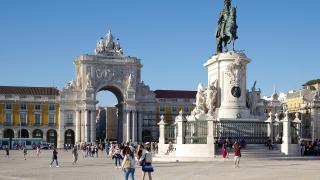
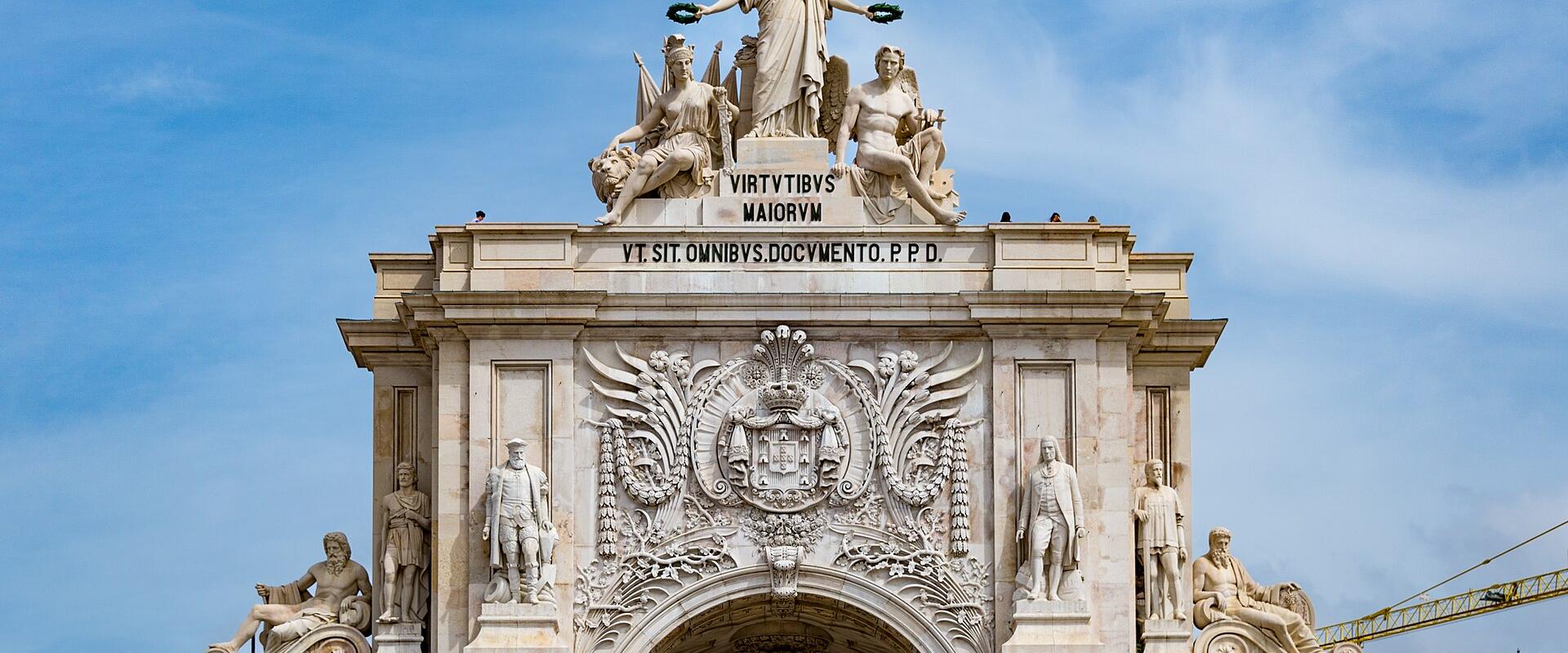
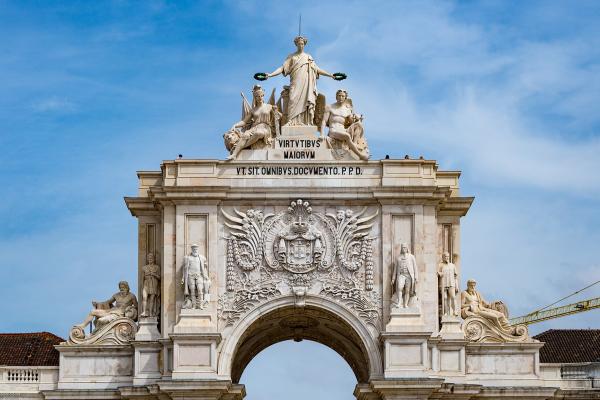
The grid opens onto two great squares. The Praça do Comércio, a huge open space beside the river, framed on three sides by arcaded yellow buildings, was the site of the royal palace before the earthquake and is now lined with cafés and government offices. In the centre stands an equestrian statue of King José I, and a monumental arch leads onto the main pedestrian street, the Rua Augusta, a lively avenue of shops, terraces, and street performers. At the other end of the grid are the squares of the Rossio and the Praça da Figueira, with their fountains, theatre, and cafés. The Santa Justa lift, an iron tower of 1902 with an observation deck, connects the Baixa with the higher district of the Chiado.
The district is flat, which makes it easy to explore, and it is the commercial centre of the city. Shops, banks, restaurants, and pastry shops line the streets, and the area is full of people from morning until late evening. Museums, theatres, and galleries are close by, and there is a vigorous scene of street art in some lanes.
The Baixa is best explored on foot. It suits all visitors, and history readers will enjoy the story of the city's reconstruction. Take care of belongings in crowds.
Categories
More photos coming soon
Nearby Attractions
Other places to visit in Lisbon
Frequently Asked Questions
Quick Facts
Best Time to Visit
March to May and September to October offer warm weather, fewer crowds, and ideal conditions for sightseeing and outdoor activities in Lisbon.