



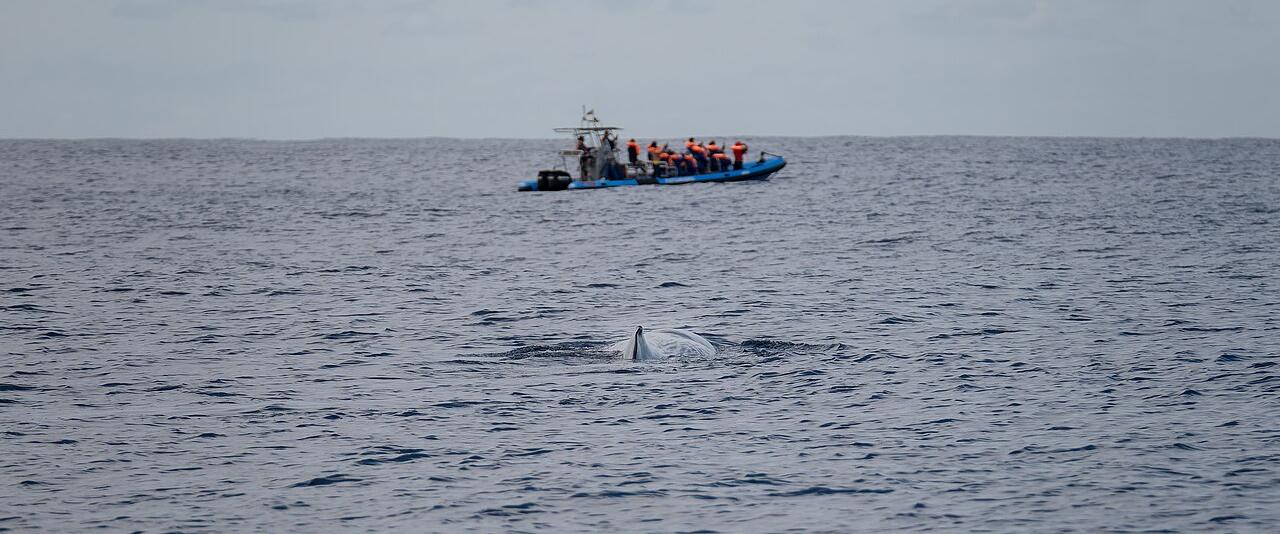
Why the Azores Are Good for Whales
The Azores are nine volcanic islands in the middle of the North Atlantic, about 1,400 km west of mainland Portugal. Deep water begins close to shore, so boats reach habitats used by large whales within a short ride from the harbour. More than 20 species of whales and dolphins have been recorded in Azorean waters, which makes the archipelago one of the best places in Europe to see them.
What You Can See in Spring
Spring, roughly March to May and into June, is the main season for the large baleen whales. Blue whales, fin whales and sei whales pass through the islands on their northward migration and often stop to feed. March to May is generally considered the most reliable window for blue and fin whales, with April and May often cited as the peak. Humpback whales are seen occasionally at this time of year.
Sperm whales are present all year. Groups of females and young live in Azorean waters, which is why sightings are possible in any month. Common and bottlenose dolphins are also seen year-round, and Risso's dolphins are regularly encountered; other dolphin species become more frequent in summer.
Sightings are never guaranteed. Wild animals move, and spring weather is changeable.
Which Island to Choose
- Pico has the strongest whale-watching tradition. Lajes do Pico, on the south coast, was a whaling centre and is now a base for whale-watching operators; the town's Museu dos Baleeiros covers the whaling era. Madalena, the ferry port facing Faial, also has operators.
- Faial, with its marina at Horta, is a short ferry crossing from Pico and has several operators working the same channel and offshore waters.
- São Miguel, the largest island, has the most flight connections and operators in Ponta Delgada and Vila Franca do Campo. It is the easiest choice if you only have a few days.
The Vigias
Commercial whaling continued in the Azores into the 1980s. Whalers relied on clifftop lookout posts called vigias, where spotters watched for blows and directed the boats by signal. Many of these lookouts are now used by whale-watching companies: a spotter with powerful binoculars scans the sea and radios the skipper, which is a large part of why success rates are high. You can see several old vigia buildings along the coasts of Pico and Faial.
Choosing a Tour
Operators in the Azores must be licensed, and regional rules limit how boats approach whales and dolphins, including how many boats can be near the same animals at once. Look for companies that work with a lookout, carry a marine biologist or trained guide, and give a briefing on the species and the rules.
Boats are usually either rigid inflatables, which are faster and closer to the water but offer no shelter, or larger catamarans or cabin boats, which are more comfortable in swell. Trips typically last around three hours. Some operators offer licensed swimming trips with dolphins; swimming with whales is not offered. Many companies will rebook or refund if a trip is cancelled because of weather, so check their policy when booking.
Planning Tips for Spring
- Build in spare days. Atlantic weather can cancel trips at short notice; book your tour early in your stay so you can reschedule.
- Dress for wind and spray. Spring air temperatures are mild, but it feels cold at sea. Bring a windproof layer and sunscreen.
- Seasickness. If you are prone to it, take precautions before departure and choose a larger boat.
- Getting there. São Miguel has direct flights from Lisbon and Porto, and Pico and Faial are reached by connecting flights or by inter-island ferry services, which run more frequently in summer.
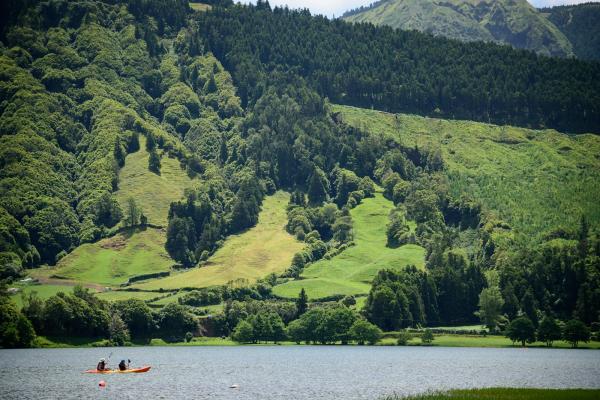
- Combine with land. Spring is also good for hiking on the islands' crater lakes and coastal paths, before the summer crowds arrive.
- Morning or afternoon? Operators run trips throughout the day; mornings often have calmer seas, but the spotters' reports matter more than the time, so ask the operator which departure they recommend.
- Learn before you go. The whaling museums on Pico, in Lajes do Pico and São Roque do Pico, explain how the islands lived from whaling until the 1980s and make the switch to whale watching easier to understand.
- Respect the animals. Keep noise down on board, follow the guide's instructions, and never ask a skipper to move closer than the rules allow.