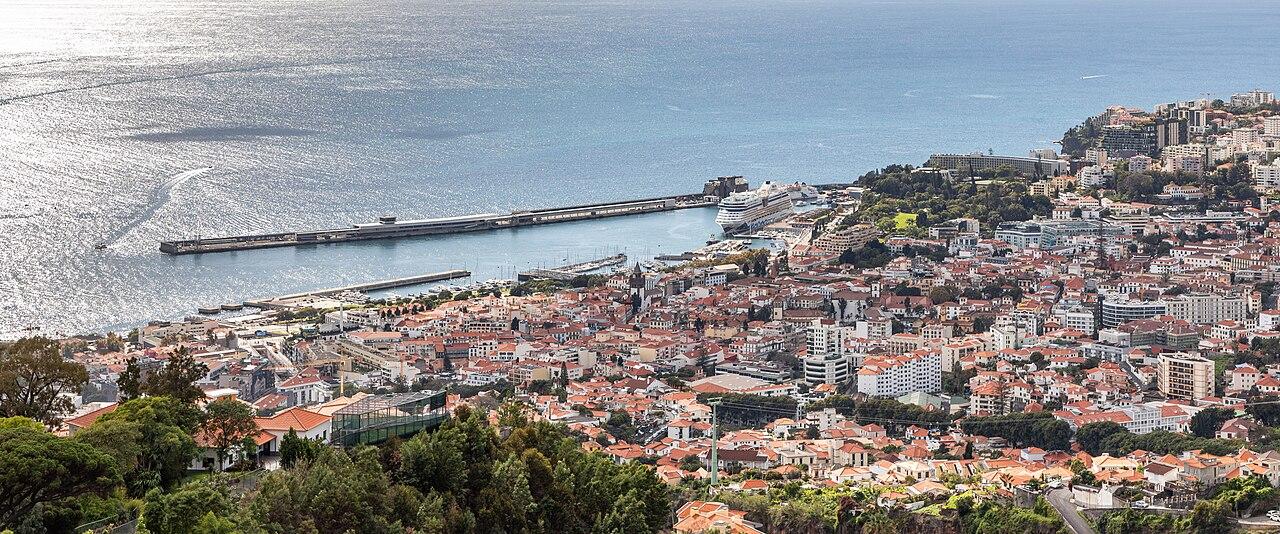
Madeira in winter is mild rather than hot. In Funchal, the capital on the sheltered south coast, December to February days average around 20–21 °C and nights 14–15 °C, the sea stays at roughly 18–19 °C, and you can expect rain on about six to nine days a month. That makes it one of the best places in Europe for walking in shirtsleeves in January, and a poor choice if all you want is to lie on a beach. The island also puts on Portugal's biggest Christmas and New Year celebrations: the lights go on in Funchal on 1 December, and the New Year's Eve fireworks over the bay are among the best known in the world. Base yourself in Funchal for the festivities and the bus network; choose the south or west coast for the most sunshine.
What the weather is like, month by month
Madeira is a steep volcanic island, and its weather changes with height and side. The south coast, where Funchal is, gets the most sun and the least wind. The north coast is greener and wetter. The high mountain spine, which reaches 1,818 m at Pico do Arieiro and 1,862 m at Pico Ruivo, can be cold, windy and wrapped in cloud while Funchal is in sunshine.
| Month | Funchal high / low | Rainfall | Rainy days | Sunshine | |---|---|---|---|---| | November | 23 / 17 °C | 80 mm | 7 | 166 h | | December | 21 / 15.5 °C | 95 mm | 9 | 151 h | | January | 20 / 14 °C | 67 mm | 6 | 161 h | | February | 20 / 14 °C | 72 mm | 5.5 | 167 h | | March | 20.5 / 14 °C | 62 mm | 6 | 198 h |
Figures are IPMA (Portugal's weather institute) averages for Funchal Observatory, 1991–2020. December is the wettest month; February and March are the driest. The sea is coolest in February and March, at about 18 °C.
In practice, a winter day in Funchal often starts bright, clouds over the mountains around midday, and clears again in the evening. Showers rarely last all day on the south coast. Up in the hills it is a different story: bring a warm layer and a rain jacket on every walk.
Practical info: Madeira's airport is on the south-east coast, about 20 minutes' drive from Funchal. Strong winds occasionally delay or divert flights, so leave slack in tight connections. Funchal has the best choice of hotels, restaurants and bus routes; Calheta and the south-west are quieter and often sunnier.
Christmas in Funchal
Christmas is the busiest season of the year in Madeira, and it starts early. The Christmas lights in Funchal are switched on at nightfall on 1 December, and the festive season runs until 7 January, closing with the Three Kings celebrations. The lights cover the old town, the seafront and the Jardim Municipal, and the cathedral square is the centre of it all.
 Christmas lights in front of Funchal Cathedral in December. Image: Dr. Thomas Liptak, CC BY-SA 4.0, via Wikimedia Commons.
Two local traditions are worth planning around:
- Missas do Parto, the "childbirth masses", begin on 15 December. Each parish holds nine of them, some starting as early as 5 a.m., and many are followed by music and food outside the church.
- Noite do Mercado (Market Night) on 23 December turns Funchal's farmers' market, the Mercado dos Lavradores, into a street party that lasts most of the night. It is the most local of the festive nights, and the busiest.
 Christmas illuminations in the Jardim Municipal, Funchal's central garden. Image: TeWeBs, CC BY-SA 4.0, via Wikimedia Commons.
The market itself is worth a daytime visit in any season, for fruit grown on the island (custard apples, passion fruit varieties, small Madeiran bananas), flower sellers and the fish hall downstairs.
 Island-grown fruit for sale at the Mercado dos Lavradores in Funchal. Image: Dietmar Rabich, CC BY-SA 4.0, via Wikimedia Commons.
Practical info: Funchal hotels fill early for the period from 20 December to 2 January, and prices rise; book months ahead. The old town (Zona Velha) and the seafront are the places to be in the evening.
New Year's Eve: the fireworks over Funchal Bay
At midnight on 31 December, fireworks are launched from points all around the amphitheatre of hills that surrounds Funchal Bay, and the whole city watches from the seafront, balconies and cruise ships in the harbour. The display lasts about eight minutes. It was classified by Guinness World Records as the world's largest fireworks display for New Year's Eve 2006–2007 and held the record until 2012.
 New Year's Eve fireworks over Funchal. Image: Mark Woodbury, CC BY 2.0, via Wikimedia Commons.
The best views are from anywhere with a clear line over the bay: the seafront promenade, the marina, hillside viewpoints and hotel terraces. Cruise ships anchor in the bay for the night. For a full guide to viewpoints and timing, see our Madeira New Year's Eve fireworks guide.
Practical info: Roads in central Funchal close in the evening and buses get crowded; walk if you can. Restaurants with a bay view sell out well in advance for 31 December.
Walking the levadas in winter
Madeira's levadas are irrigation channels cut along the mountainsides from the 16th century onwards to carry water from the wet north to the farmed south. The maintenance paths beside them are now the island's walking network, and winter is a good time to use it: cool, green and with the waterfalls running.
 A waterfall beside the Levada do Caldeirão Verde, one of Madeira's best-known levada walks. Image: Josep M. Gracia, CC BY-SA 4.0, via Wikimedia Commons.
Three classics show the range:
- Levada do Caldeirão Verde (PR9) runs through laurel forest from Queimadas, near Santana in the north, to a waterfall that drops into a pool below. It includes tunnels, so bring a torch.
- Levada das 25 Fontes (PR6) in the west, from Rabaçal, ends at a pool fed by dozens of small springs.
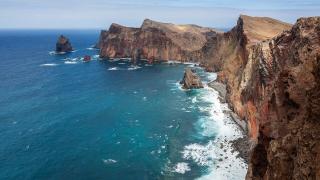
- Ponta de São Lourenço (PR8) is the opposite: a dry, treeless walk along the cliffs of the island's eastern tip, and usually the sunniest walk on Madeira in winter.
 Water running beside the Levada das 25 Fontes path in the west of the island. Image: muffinn from Worcester, UK, CC BY 2.0, via Wikimedia Commons.
 The cliffs and islets of Ponta de São Lourenço, the dry eastern tip of Madeira. Image: Diego Delso, CC BY-SA 4.0, via Wikimedia Commons.
The ridge walk between Pico do Arieiro and Pico Ruivo is the island's most dramatic. In winter it can be icy, windy or completely in cloud, so treat it as a fine-weather-only option and check its status before going.
 The mountains seen from the Pico do Arieiro viewpoint at 1,818 m. Image: H. Zell, CC BY-SA 3.0, via Wikimedia Commons.
Practical info: The official walking routes now require an advance booking for a time slot, made on the regional government's SIMplifica platform, and non-residents pay a per-person fee (€4.50 per route for independent walkers in 2026; check the current price). Trails close after landslides and storms, and some stay closed for months; check the IFCN (the regional forestry and nature service) list of open routes before you set out. Wear proper shoes, carry a waterproof and a torch, and start early: in December the sun sets at around 6 p.m. For route ideas, see Madeira's best levada walks.
Gardens and Monte
Madeira's gardens are at their most colourful in winter and early spring. The Madeira Botanical Garden sits on the hillside above Funchal with views over the harbour. In Monte, reached by cable car from the seafront, the Monte Palace Tropical Garden combines exotic plants, Japanese-style ponds and a large collection of Portuguese tiles. Monte is also where the wicker toboggans (carros de cesto) start their run down the steep streets towards Funchal, steered by two men in white.
 Ponds and bridges in the oriental garden of the Monte Palace Tropical Garden. Image: H. Zell, CC BY-SA 3.0, via Wikimedia Commons.
Practical info: Take the cable car up from the Zona Velha and walk or ride back down; the botanical garden is linked to Monte by a second cable car.
Day trips around the island
Madeira is small, about 57 km from east to west, but the roads climb and twist, and the tunnels that cut through the ridges are what make day trips easy. Four outings work well in winter:
- Câmara de Lobos and Cabo Girão. Câmara de Lobos, a fishing village just west of Funchal, is where Winston Churchill painted the harbour during his stay in 1950. A few minutes further on, the Cabo Girão viewpoint has a glass-floored platform on top of one of the highest sea cliffs in Europe, about 580 m above the water. Go on a clear morning; when cloud sits on the cliff there is nothing to see.
- Santana and the north coast. Santana is known for its triangular, thatched houses, a few of which are kept as a small visitor area in the village. The road along the north coast passes waterfalls that run strongly in winter; the coast is also where the Caldeirão Verde levada starts.
- Porto Moniz. On the north-west tip, Porto Moniz has natural swimming pools formed in the black lava rock. In winter the Atlantic swell often crashes over them, which is a sight in itself; swimming depends on the sea and on whether the pools are open.
- Paul da Serra and Rabaçal. The high plateau in the west is the starting point for the 25 Fontes and Risco levadas. It is often colder and foggier than anywhere else on the island, so this is a day for a fleece and a good forecast.
Practical info: Guided day tours from Funchal cover the north coast and the west in a day. If you drive yourself, allow more time than the distances suggest, and avoid the mountain roads after dark in fog.
Where to stay in winter
- Funchal for Christmas, New Year, restaurants and buses. The Zona Velha (old town) is the liveliest area; the Lido hotel zone, west of the centre, is quieter and has seawater pools.
- Calheta and the south-west for sunshine, a small sheltered beach and quick access to the western levadas.
- Santana or the north coast only if you want walking first and don't mind more cloud and rain.
Porto Santo: a beach island for calm days
Porto Santo, Madeira's small sister island to the north-east, is everything Madeira isn't: low, dry and fringed by a long sandy beach. In winter it is quiet, many seasonal businesses close, and the water is too cool for most swimmers, but on a calm, sunny day it makes a peaceful walk on the sand. The ferry from Funchal takes around two and a half hours and can be rough in winter; there are also short flights. More: Porto Santo.
Who Madeira in winter suits
- Walkers: the best season for levadas below the high peaks.
- Christmas and New Year lovers: Funchal is one of Europe's most festive small cities in December.
- Garden lovers and slow travellers: mild days, cafés and viewpoints.
- Not ideal for: guaranteed beach days and sea swimming; for that, look at the Canary Islands further south.
Want a wellness break rather than hiking? Portugal's other Atlantic archipelago does winter retreats well: see winter wellness retreats in the Azores. If you stay into February, Madeira's Carnival follows the festive season: see our Madeira Carnival guide.
Tips for a winter trip
- Book Christmas and New Year early, flights and hotels alike.
- Base yourself in Funchal without a car; buses reach most trailheads, and taxis and tours fill the gaps. Hire a car if you plan several walks in the west or north.
- Check the mountain forecast, not just Funchal's, before any walk above 1,000 m.
- Pack layers: warm days on the coast, cold and wet up high.
More on the island: Funchal and the Madeira region guide.


,_Mercado_dos_Lavradores_--_2025_--_0961.jpg)


.jpg)


