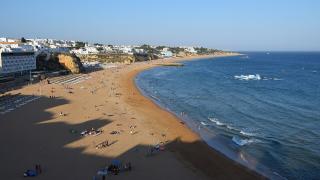
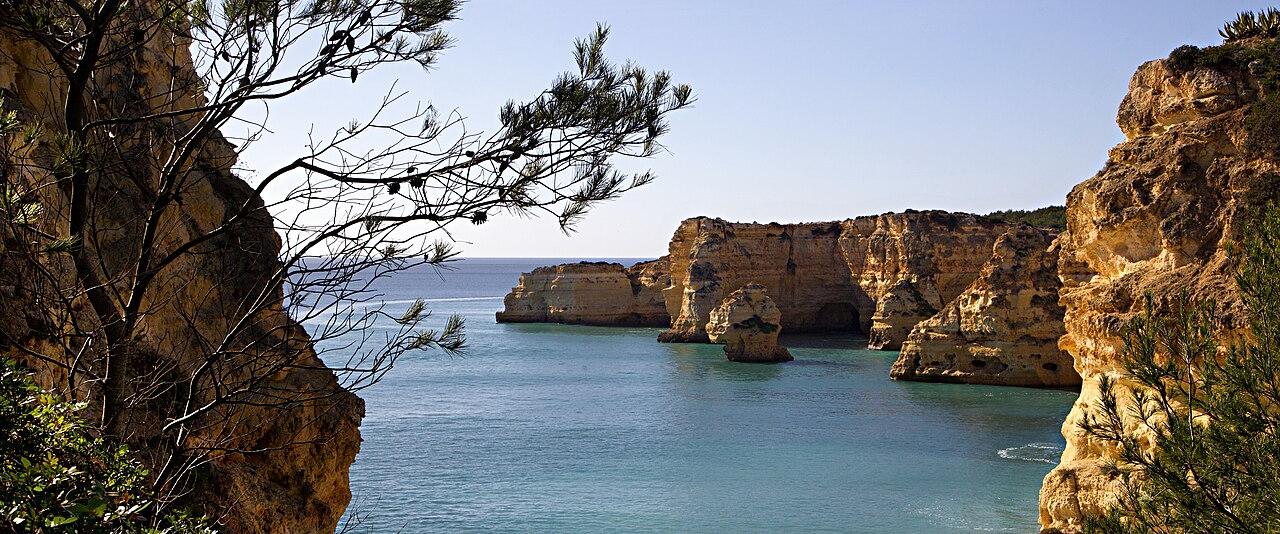
The Algarve in winter is sunny and quiet rather than warm. In Faro, December to February afternoons average 16–17 °C and nights 8–10 °C, it rains on about five to seven days a month, and the sea drops to around 16–17 °C, too cold for most swimmers. What you get instead is light: some of the sunniest winter weather in mainland Europe, empty beaches under the golden cliffs, comfortable walking, golf in its main season, and almond trees in flower from late January. It suits walkers, golfers, couples and anyone escaping a northern winter for a week of blue skies. Base yourself in a real town that lives all year, such as Tavira, Faro or Lagos, rather than a resort that empties out.
Winter weather, month by month
| Month | Faro high / low | Rainfall | Rainy days | Sunshine | |---|---|---|---|---| | November | 19.5 / 12 °C | 76 mm | 7 | 192 h | | December | 17 / 10 °C | 90 mm | 7 | 159 h | | January | 16 / 8 °C | 49 mm | 6 | 182 h | | February | 17 / 9 °C | 42 mm | 5 | 172 h | | March | 19 / 11 °C | 47 mm | 6 | 243 h |
Temperatures and rainfall are IPMA (Portugal's weather institute) averages for Faro, 1991–2020; sunshine is a longer-term average. December is the wettest month and January the coolest. From February the days lengthen quickly, and March, with more than 240 hours of sun, often feels like spring.
Rain in the Algarve tends to come in short spells of a day or two when an Atlantic front passes, followed by clear, fresh weather. Evenings are cool enough for a jacket, and old Algarve houses are built for summer, so if you rent a villa or apartment, check that it has proper heating.
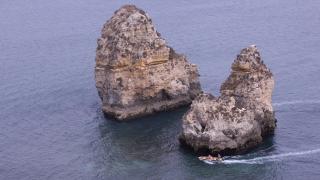
 The sea stacks and arches of Ponta da Piedade near Lagos. Image: Otávio Nogueira from Fortaleza, BR, CC BY 2.0, via Wikimedia Commons.
Practical info: Faro airport is the gateway, a short drive from Faro town and about an hour from Lagos or Tavira. Regional trains run along the coast between Lagos and Vila Real de Santo António, calling at Faro and Tavira; buses connect the rest. A hire car is the easiest way to reach the western beaches and inland villages.
Beaches in winter: walk them, don't plan to swim
Winter is the best time to see the Algarve's famous coastline without the crowds. The western half, the Barlavento, is the cliff coast: golden limestone eroded into coves, stacks and arches. Praia da Marinha, near Carvoeiro, is the classic picture, and in January you may have its steps and viewpoints almost to yourself. Further west, the rock formations of Ponta da Piedade outside Lagos are reached by boardwalks and steps along the clifftop.
 Inside the sea cave at Benagil, on the cliff coast near Carvoeiro. Image: Kolforn (Kolforn) I'd appreciate if you could mail me (Kolforn@gmail.com) if you, CC BY-SA 4.0, via Wikimedia Commons.
The Benagil sea cave, between Carvoeiro and Armação de Pêra, has strict rules since August 2024: you may not land on the beach inside the cave or swim into it, kayaks in the cave area must go with a guide, and the number of boats inside at once is limited. Boat trips run in winter when the sea is calm enough, which is not every day; ask the operator the evening before.
The eastern half, the Sotavento, is flatter, with long sandy beaches on barrier islands in front of the Ria Formosa lagoon, reached by small ferries from Faro, Olhão and Tavira. Winter ferry timetables are reduced, so check the return time before you go.
Practical info: Lifeguards and beach services are seasonal, so in winter you are on your own; respect the red flags and keep away from cliff edges and overhangs, which collapse after heavy rain.
The Seven Hanging Valleys trail
The Algarve's best-known coastal walk, the Percurso dos Sete Vales Suspensos (PR1 LGA), runs along the clifftops between Praia da Marinha and Praia de Vale de Centeanes near Carvoeiro, about 5.7–6 km one way. It takes its name from the dry valleys that end abruptly at the cliff edge high above the sea, and it passes Benagil and the cliffs above the cave on the way. In summer the heat makes it hard work; in winter it is a pleasure, especially on a clear morning after rain.
Practical info: The trail is linear, so either walk there and back (about 11–12 km) or arrange a taxi for one leg. There is little shade and no fence along most of the cliff edge; stay on the path. Wear proper shoes: the path is sandy and uneven in places. More on the area: Carvoeiro.
Almond blossom: January and February
From around mid-January into February, the almond trees of the Algarve's inland hills, the barrocal, flower white and pale pink. A local legend, set in Moorish Silves, explains it: a ruler of Silves married a princess from the snowy north who pined for the sight of snow, so he planted almond trees across the hills, and when they blossomed white she was cured of her homesickness.
 Almond blossom near Alvor in mid-February. Image: muffinn from Worcester, UK, CC BY 2.0, via Wikimedia Commons.
The trees are scattered along the back roads between the coast and the hills of the Serra do Caldeirão, around villages such as Alte and in the eastern hills inland from Castro Marim, where a small almond blossom festival is held in the village of Alta Mora in February (dates change each year). The blossom depends on the weather, so check recent photos from local groups before driving out.
Towns that stay alive in winter
Resort strips such as parts of Albufeira and the newer developments between the towns quieten down sharply in winter, and many beach restaurants, bars and some hotels close between November and March. The historic towns are different, because people live there all year.
- Tavira is the prettiest: a town of churches and whitewashed houses on both banks of the River Gilão, joined by an old pedestrian bridge. Its beach, Ilha de Tavira, is on a barrier island reached by ferry. More: Tavira.
- Faro has a walled old town (Cidade Velha) entered through the Arco da Vila gate, a cathedral with views over the lagoon, and the most restaurants that stay open all winter. More: Faro.
- Lagos, at the western end, is a working town with old walls, a marina and the best access to the cliff coast.
- Silves, inland, was the capital of the region under Moorish rule, and its red sandstone castle still dominates the town.
 The old bridge over the River Gilão in Tavira. Image: Alexkom000, CC BY 4.0, via Wikimedia Commons.
 The Arco da Vila gateway into Faro's old town. Image: Marc Ryckaert (MJJR), CC BY 3.0, via Wikimedia Commons.
 The red sandstone walls of the castle of Silves. Image: Joachim Schulz Emsland, CC BY-SA 4.0, via Wikimedia Commons.
Practical info: Tavira and Faro are on the coastal railway; Silves station is outside the town, so a short taxi or walk follows. Restaurants in the old towns serve the winter dishes: cataplana stews, grilled fish and, in the hills, game and chickpea stews.
Inland days: Monchique, Loulé and the Ria Formosa
On a grey or windy day, head inland or into the lagoon rather than to the beach.
- Serra de Monchique. The hills behind Portimão rise to 902 m at Fóia, the highest point of the range, with views over the whole western coast when it is clear. On the way up, Caldas de Monchique is an old spa village built around geothermal springs, set in woods of cork oak and eucalyptus. Fóia is often in cloud and much colder than the coast, so go on a clear day and take a warm layer.
- Loulé. This inland market town is known for its municipal market, an Arabic-inspired hall built in the years before 1910, full of local produce: citrus fruit, almonds, figs, honey and medronho, the strawberry-tree spirit made in the hills. The old streets around the castle walls are worth an hour's wander.
- Ria Formosa. The lagoon system that runs along the coast from west of Faro to beyond Tavira has been a natural park since 1978 and is an Important Bird Area. Winter is a good time to see waders on the mudflats at low tide; walking trails start near Quinta do Lago and Olhão, and boat trips run from Faro and Olhão when the weather allows.
 Salt pans and marshes on the edge of the Ria Formosa near Tavira. Image: Dmitry Tonkonog, CC BY-SA 3.0, via Wikimedia Commons.
A week in the Algarve in winter
A simple plan that works with short days and changeable weather:
- Day 1–2: Tavira. The old town, the river, a ferry to Ilha de Tavira for a beach walk, and a lunch in Cacela Velha above the lagoon.
- Day 3: Faro and Loulé. Faro's old town in the morning, Loulé's market and streets in the afternoon.
- Day 4: the cliff coast. The Seven Hanging Valleys trail from Praia da Marinha, with a stop at the Benagil viewpoint.
- Day 5: Silves and Monchique. The castle in the morning, Fóia and Caldas de Monchique if it is clear.
- Day 6: Lagos and Ponta da Piedade. Clifftop boardwalks and the old town.
- Day 7: Sagres and Cape St Vincent. The far west, ending with sunset at the cape.
Swap days around the forecast: keep the coast for the sunny days and the towns and markets for the wet ones.
Golf in winter
Winter and spring are the Algarve's main golf season. The courses are concentrated in the central Algarve, around Vilamoura, Quinta do Lago and Vale do Lobo, with more around Lagos and Carvoeiro and in the east near Tavira and Castro Marim. Mild days and dry fairways bring golfers from across northern Europe, so tee times and golf hotels around Christmas, New Year and February half-term need booking ahead.
The far west: Sagres and Cape St Vincent
At the south-western tip of mainland Europe, Cabo de São Vicente is the end of the road: a lighthouse, built in 1846, on cliffs that rise about 75 m straight out of the open Atlantic. In winter it is wild, windy and dramatic, with storm-force swell on some days and very few visitors on others. The nearby town of Sagres is a surfers' base, and the coast north of here, the Costa Vicentina, is a protected natural park with long walking routes.
 The lighthouse at Cabo de São Vicente, the south-western tip of mainland Europe. Image: Matthias Süßen, CC BY-SA 4.0, via Wikimedia Commons.
Practical info: Bring a windproof jacket; the cape is usually several degrees cooler than Faro and much windier. Sunset here is a popular sight all year.
Christmas and New Year
The Algarve's towns put up lights and nativity scenes in December and run their own programmes of Christmas events, on a smaller scale than Lisbon or Porto. On New Year's Eve, the larger towns and resorts, among them Albufeira, Portimão and Faro, hold free outdoor concerts and fireworks; the programmes are announced by the town halls in December. Christmas Eve (Consoada) is a family meal at home, so expect some restaurants to close that evening and on Christmas Day.
Tips for a winter trip
- Choose a town, not a resort, for open restaurants and evening life.
- Check heating in rented accommodation.
- Pack for 8 °C mornings and 18 °C afternoons, plus a rain layer.
- Book Christmas, New Year and February golf weeks early; the rest of the winter is the cheapest time to visit.
- Plan beach days as walks; for winter sea swimming, look at the Canary Islands or Madeira instead.
More on the region: the Algarve region guide, Albufeira, and, for a winter break with more warmth and walking, Madeira in winter.
.jpg)
.JPG)
.jpg)


