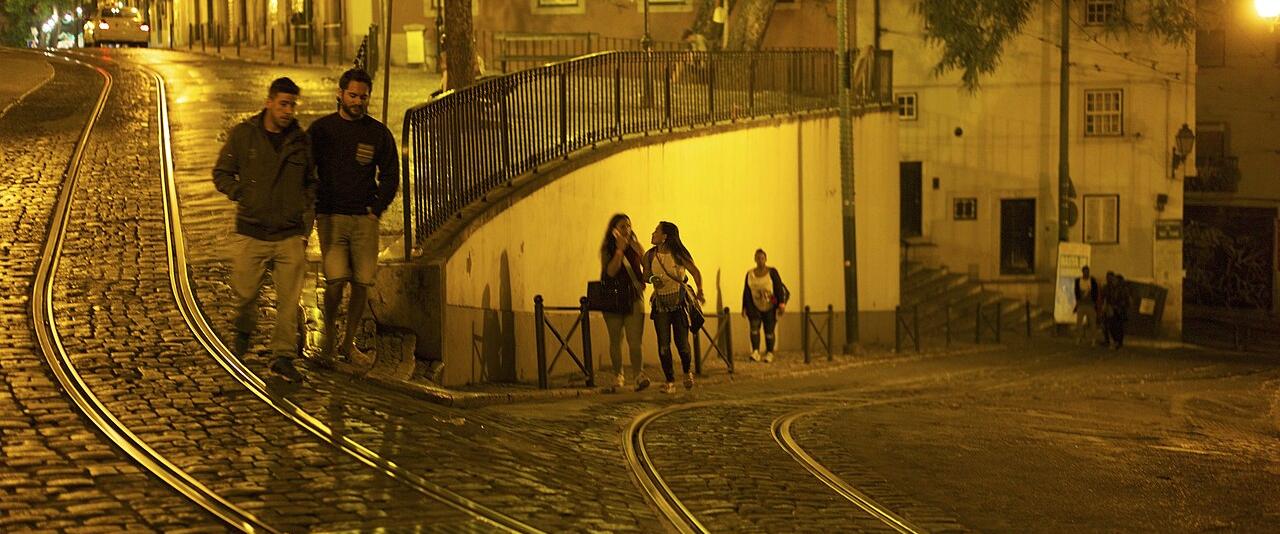
Lisbon is the city of yellow trams, fado drifting out of Alfama doorways and pastéis de nata still warm from the oven. It is also the city where a mob killed thousands of converted Jews over three days in 1506, where the Inquisition read out its sentences in the main square, and where an earthquake, a tsunami and a fire destroyed most of the city in a single morning. Its wealth was built in part on the Atlantic slave trade, a king and his heir were shot dead in its grandest square, and a dictatorship's secret police fired into a crowd here on the day that dictatorship fell.
Almost all of it left a mark you can still find: a stone sphere outside a scorched church, a roofless convent, a pillar in a Belém alley, a prison that is now a museum. This guide follows those marks in order, from the 12th century to the present, and tells you where to find each one. Some of the memorials are recent, and one, to the people Lisbon enslaved, has still not been built.
1147: A Broken Surrender
Lisbon became Portuguese through a siege. From 1 July to 25 October 1147, Afonso Henriques, the first king of Portugal, besieged the Muslim city with the help of crusaders from Flanders, Germany and England who had stopped on their way to the Holy Land. The surrender terms promised the garrison their lives and property. The crusaders broke them: they looted the city and killed its Mozarabic bishop, the leader of the Christians who had lived under Muslim rule. Plague followed.
The well-known story of Martim Moniz, the knight who supposedly jammed his body in a castle gate so it could not close, is a legend; no contemporary source records it.
Where to see it today: the walls of the Castelo de São Jorge, above Alfama, stand on the line of the Moorish citadel. The Martim Moniz metro station and square at the foot of the hill are named after the legend.
1506: Three Days of Killing at São Domingos
In 1497 King Manuel I forced Portugal's Jews to convert to Christianity. They became "New Christians", and many Lisboners never trusted them. On 19 April 1506, during a mass at the church of São Domingos, worshippers claimed to see a miracle in a crucifix. A New Christian in the congregation doubted it aloud. He was dragged outside and killed.
Dominican friars then led a procession through the streets urging the crowd to kill more. Sailors from German and French ships in the harbour joined in. For three days, people suspected of being New Christians were killed in their homes and in the streets, and the bodies were burned on pyres in the square, in the Rossio and by the river. Order returned only on the Thursday. Estimates of the dead range from about 500 to more than 4,000; 2,000 is the figure most often cited. No one counted. The king later had two of the friars garroted and burned.
 The 2008 memorial in Largo de São Domingos: "In memory of the thousands of Jews, victims of intolerance and religious fanaticism, murdered in the massacre that began on 19 April 1506 in this square." Image: Dreamcatcher25, CC BY-SA 4.0, via Wikimedia Commons.
Where to see it today: the memorial stands in Largo de São Domingos, just off the Rossio: a stone sphere with a Star of David by the sculptor Graça Bachmann, inaugurated in 2008. Behind it a wall reads "Lisboa, cidade da tolerância" (Lisbon, city of tolerance) in 34 languages. In 2000 the Patriarch of Lisbon apologised for the Church's treatment of Jews.
The Inquisition on the Rossio
The Portuguese Inquisition was established in 1536 and held its first auto-da-fé, a public ceremony at which sentences were read out, in 1540. Its Lisbon tribunal sat in the Estaus Palace on the north side of the Rossio. Autos-da-fé were staged in the Rossio and in the Terreiro do Paço, the great square on the river; the people condemned to death were then marched to a separate execution ground more than a kilometre away. Sentences were also read in the church of São Domingos.
 An auto-da-fé procession in Lisbon, from an 18th-century engraving. Image: Unknown authorUnknown author, Public domain, via Wikimedia Commons.
According to the historian Henry Charles Lea, Portugal's four tribunals burned 1,175 people alive and 633 in effigy between 1540 and 1794, and punished 29,590 others. The records have gaps, so those are minimum figures. The Inquisition was abolished in 1821.
 The Estaus Palace on the Rossio, seat of the Inquisition, before it burned down in 1836. Image: first half of 19th century, Public domain, via Wikimedia Commons.
Where to see it today: the Teatro Nacional D. Maria II stands on the site of the Estaus Palace, at the north end of the Rossio. It reopened in September 2026 after three years of restoration. Across the square, the church of São Domingos is a reminder in itself: a fire in 1959 gutted the interior and killed two firefighters, and when it reopened in 1994 the scorched columns and blackened walls were left as they were.
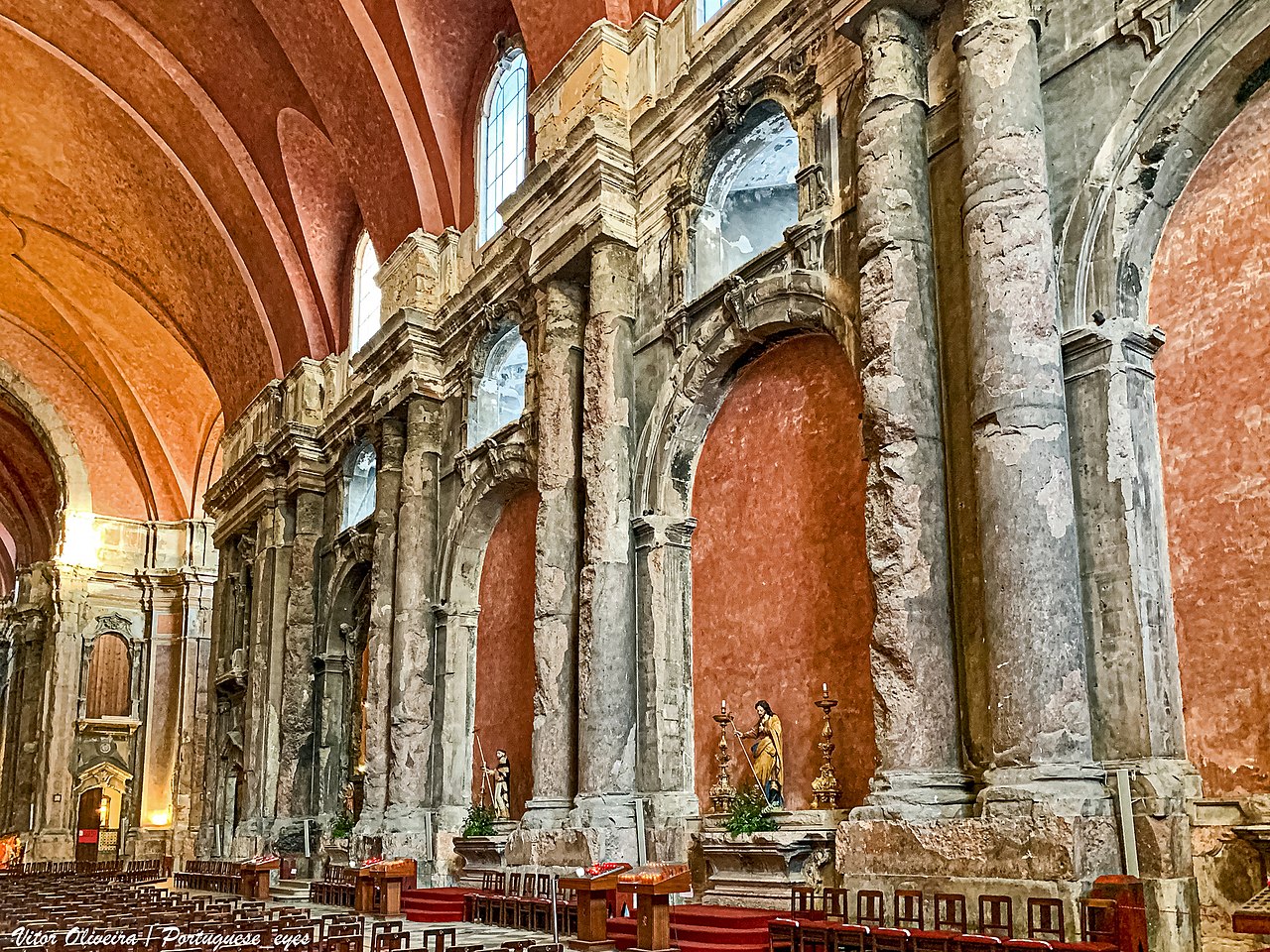 The fire-scarred interior of São Domingos, left unrestored after the fire of 1959. Image: Vitor Oliveira from Torres Vedras, PORTUGAL, CC BY-SA 2.0, via Wikimedia Commons.
Lisbon and the Slave Trade
The first large sale of enslaved Africans in Europe took place in Lagos, in the Algarve, in 1444. From the 1480s Lisbon became the main port of entry, with a Casa dos Escravos (House of Slaves) set up in 1486 to manage the trade. By the middle of the 16th century there were about 10,000 enslaved Africans in Lisbon, roughly a tenth of the city's population. Over the whole history of the Atlantic trade, ships under the Portuguese and Brazilian flags carried more than 5.8 million of the roughly 12.5 million people taken from Africa, more than any other nation.
 Black and white Lisboners at the Chafariz d'El-Rey fountain, painted around 1570–80. Image: anonymous, Public domain, via Wikimedia Commons.
In 1515 Manuel I ordered a pit dug for the bodies of enslaved people that were being left in the streets. The street that grew up on the spot is still called Rua do Poço dos Negros, "street of the Black people's pit". Portugal banned the import of enslaved people into the mainland in 1761, ended the trade in 1836 and abolished slavery throughout its empire in 1869.
The country is still arguing about what it owes. In April 2024 President Marcelo Rebelo de Sousa said Portugal had to "pay the costs" of slavery and colonialism; days later the government said no reparations process was planned.
Where to see it today: Rua do Poço dos Negros runs between São Bento and Santa Catarina, and the Afro-Portuguese association Batoto Yetu has set a plaque into its pavement. A national memorial to enslaved people, Plantação by the Angolan artist Kiluanji Kia Henda (540 black aluminium sugar canes around an open amphitheatre), won a public vote in 2019. In June 2025 the city confirmed it would stand at Ribeira das Naus, the riverfront west of the Praça do Comércio, but it has not been built and no date has been set.
1 November 1755: Earthquake, Wave and Fire
On All Saints' Day 1755, at about 9:40 in the morning, while much of the city was at mass, an earthquake with an estimated magnitude of 7.7 or more struck Lisbon. The epicentre was in the Atlantic, about 290 km to the southwest. Churches collapsed on their congregations. People who ran to the open riverfront were caught by a tsunami about 40 minutes later. Fires, many started by candles lit for the holy day, burned for days.
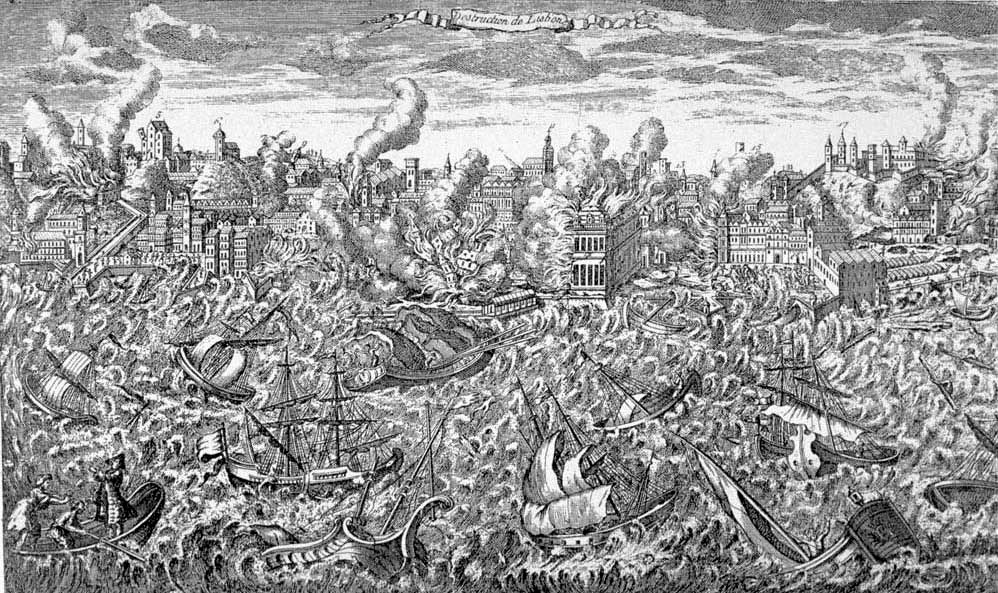 A contemporary engraving of Lisbon burning while the tsunami overwhelms ships in the harbour. Image: Unknown authorUnknown author, Public domain, via Wikimedia Commons.
Between 30,000 and 40,000 people died in Lisbon, according to current estimates; older figures range from 10,000 to more than 90,000. The disaster shook European thought (Voltaire wrote a poem about it and mocked the optimism of the day in Candide), and the king's minister, later the Marquis of Pombal, rebuilt the Baixa on a strict grid, with buildings framed in timber cages designed to flex in a future earthquake.
 The nave of the Carmo Convent, left roofless since 1755. Image: Vitor Oliveira from Torres Vedras, PORTUGAL, CC BY-SA 2.0, via Wikimedia Commons.
Where to see it today: the Carmo Convent on Largo do Carmo was never re-roofed, and its open nave houses the Museu Arqueológico do Carmo (Monday to Saturday, closed Sundays). The orderly streets of the Baixa are the rebuilt city. The Quake museum, on Rua Cais da Alfândega Velha in Belém, recreates the earthquake with simulators.
1759: The Távoras and the Salted Ground
On the night of 3 September 1758, shots were fired at the carriage of King José I as he returned from a night with his mistress, a Távora by marriage. He survived. Pombal used the attack to destroy his rivals among the high nobility. The Távora family and the Duke of Aveiro were accused, tortured and condemned.
Overnight on 12–13 January 1759 a scaffold was built in Belém. The elderly Marchioness of Távora was beheaded. Her husband, her sons and the Duke of Aveiro, among others, were broken with sledgehammers on the wheel before being strangled with the garrote. The king watched. The condemned families' palaces were razed and the ground was salted so that nothing would grow there.
 The scaffold in Belém on 13 January 1759, from a contemporary print. Image: Unknown authorUnknown author, Public domain, via Wikimedia Commons.
Where to see it today: in Beco do Chão Salgado ("alley of the salted ground"), a narrow lane off Rua de Belém, a stone pillar still stands on the site of the Duke of Aveiro's demolished house. Its inscription records why the house was destroyed and the ground salted. The Igreja da Memória, uphill in Ajuda, was built where the king's carriage was attacked.
 The 18th-century pillar in Beco do Chão Salgado, Belém. Image: Vitor Oliveira from Torres Vedras, PORTUGAL, CC BY-SA 2.0, via Wikimedia Commons.
The Aqueduct Murders That Probably Weren't
The Águas Livres Aqueduct, finished in the 18th century, survived the 1755 earthquake almost undamaged and still crosses the Alcântara valley on arches up to 65 metres high. Every guide to dark Lisbon repeats the story of Diogo Alves, a Galician-born robber said to have thrown dozens of victims off it in the 1830s. Alves was real: he was hanged on 19 February 1841 for the robbery and murder of five people in a doctor's house in the city. The aqueduct killings, though, do not appear in his indictment or his sentence, and the story first appears in print after his death. A 2025 study by the historian Miguel Carvalho Abrantes also argues that the head displayed as his at the Faculty of Medicine is almost certainly someone else's.
 Inside the Águas Livres Aqueduct, whose dark legend outgrew the facts. Image: Terry Kearney from liverpool, merseyside, CC0, via Wikimedia Commons.
Portugal was one of the first countries to abolish the death penalty: for political crimes in 1852, for civil crimes in 1867 and for all crimes in 1911.
Where to see it today: the arches cross the Alcântara valley in Campolide and are best seen from the road below. The Museu da Água runs visits to the aqueduct and to the Mãe d'Água reservoir at Amoreiras, where it ends.
1 February 1908: The Regicide
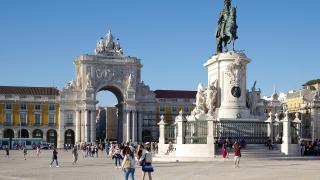
On the afternoon of 1 February 1908, King Carlos I and his family were driven in an open carriage across the Terreiro do Paço, today's Praça do Comércio. As the carriage turned towards Rua do Arsenal, two republican activists opened fire. Manuel Buíça, a teacher and former army sergeant, shot the king with a carbine. Alfredo Luís da Costa, a shop clerk, jumped onto the carriage step; Crown Prince Luís Filipe fired back at him and was then killed by a rifle shot. Both assassins were killed on the spot, along with a bystander. The king's younger son became Manuel II, and two years later the monarchy fell.
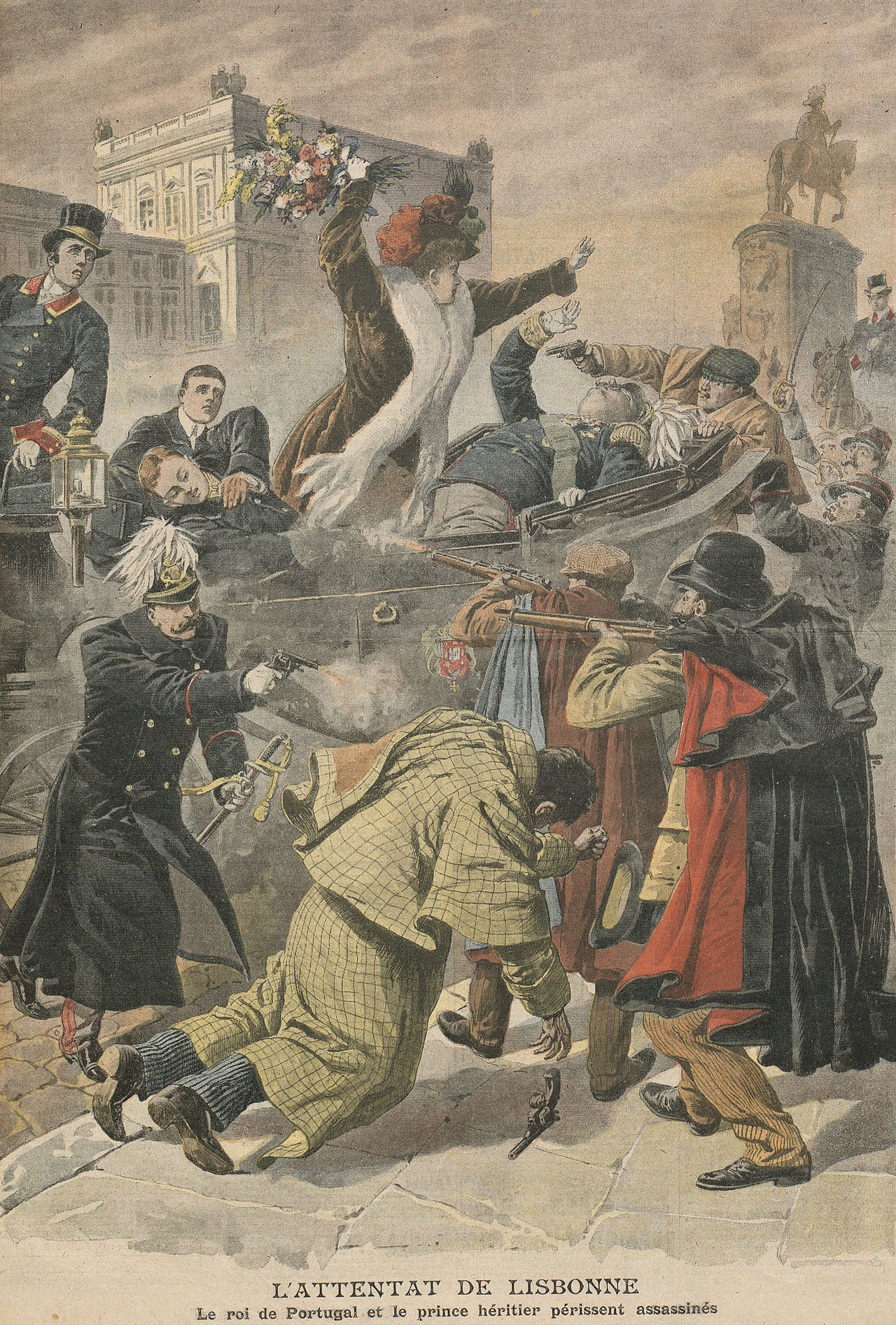 The assassination as shown on the cover of the French magazine Le Petit Journal, February 1908. Image: Le Petit Journal, Public domain, via Wikimedia Commons.
Where to see it today: the killings happened at the western corner of the Praça do Comércio, where it meets Rua do Arsenal. The carriage itself, with its bullet holes, is in the Museu Nacional dos Coches in Belém.
1933–1974: The Dictatorship and Its Police
For more than 40 years Portugal was ruled by the Estado Novo dictatorship of António de Oliveira Salazar and his successor, Marcelo Caetano. Its political police, the PIDE (renamed DGS in 1969), arrested, tortured and imprisoned opponents. Many passed through the Aljube prison beside Lisbon cathedral, where political prisoners were held in tiny windowless cells known as curros. Some 30,000 political prisoners are estimated to have passed through it between 1928 and 1965.
On 25 April 1974 the army overthrew the regime in a largely bloodless coup that became known as the Carnation Revolution. That evening, as crowds gathered outside the PIDE headquarters on Rua António Maria Cardoso in Chiado, agents fired from the windows. Four people were killed and 45 wounded: João Arruda, Fernando Giesteira, José Barneto and Fernando dos Reis. A PIDE employee, António Lage, was also shot dead by soldiers. So, despite the legend, the revolution was not quite bloodless: five people died in Lisbon that day.
 The former Aljube political prison, now the Museu do Aljube – Resistência e Liberdade. Image: Ardfern, CC BY-SA 4.0, via Wikimedia Commons.
Where to see it today: the Museu do Aljube, Rua de Augusto Rosa 42, beside the cathedral, tells the story of the dictatorship from inside the prison (Tuesday to Sunday, 10:00–18:00). The former PIDE headquarters at Rua António Maria Cardoso 22 is now luxury flats; two plaques by the door, one from 1980 and one placed by the city in 2024, name the four people killed. Caetano surrendered at the Carmo barracks on Largo do Carmo, next to the ruined convent.
1988: The Chiado Fire
Shortly before 5:00 on the morning of 25 August 1988, fire broke out in the Grandella department store on Rua do Carmo. Fire engines could not get close because of the planters and street furniture of the newly pedestrianised street. The fire destroyed 18 buildings in the heart of Chiado, including the Grandes Armazéns do Chiado department store and an archive of historic sound recordings. Two people died: a firefighter, Joaquim Ramos, and a retired man whose body was found in the rubble 58 days later. The architect Álvaro Siza Vieira led the reconstruction, keeping the old façades.
Where to see it today: walk down Rua do Carmo and Rua Garrett. The buildings you see between them are Siza Vieira's rebuild behind the old fronts.
Today's Shadows
Lisbon is a safe city by European standards, but visitors meet a few things the postcards leave out.
- Fake drugs in the Baixa. Men on Rua Augusta and around the Rossio murmur offers of hashish and cocaine. Portugal decriminalised personal drug use in 2001, but these sellers are not part of that: according to the police, most of what they sell is pressed bay leaf, and the sellers can only be fined. In August 2026 a tourist was hit by a stray bullet on Rua Augusta during a fight between rival sellers. Walk on and don't engage.
- Pickpockets on tram 28. The famous tram through Alfama and Graça is packed and is the city's best-known pickpocketing spot; there are warning notices on board.
- The housing crisis. Rents have outpaced Portuguese wages, and short-term holiday lets have taken over whole streets in Alfama and Mouraria. Thousands have marched under the slogan "Casa para Viver" (a home to live in) since 2023, and new short-term rental licences are frozen in the historic districts. The tourist tax is €4 per person per night, for up to 7 nights.
- Intendente. The square at the top of Mouraria was for decades Lisbon's red-light and drug district. Mayor António Costa moved his office there in 2011 to help turn it around, and it is now full of cafés, but street dealing and sex work have not disappeared from the side streets.
 Tram 28 in the Baixa: the city's icon and its pickpockets' favourite route. Image: Vicuna R from Germany, CC BY-SA 2.0, via Wikimedia Commons.
How to visit: keep bags zipped and in front of you on trams and in crowds, ignore the street sellers, and remember that the old districts are still home to the people who live there. Keep your voice down in residential streets at night.
How to See Dark Lisbon Respectfully
A self-guided walk, about 4 km. Start at the Largo de São Domingos memorial and step inside the scorched church. Cross the Rossio to the Teatro Nacional on the site of the Inquisition. Climb to Largo do Carmo and the roofless convent, then walk down Rua Garrett and Rua do Carmo through the rebuilt Chiado. Find the plaques at Rua António Maria Cardoso 22, then walk down to the Praça do Comércio and its western corner, where the king was shot. Follow the river east and climb to the cathedral and the Museu do Aljube, and finish at the Castelo de São Jorge.
Further afield:
- Beco do Chão Salgado, the Coach Museum and the Quake museum in Belém (tram 15 from Praça da Figueira).
- Rua do Poço dos Negros, between São Bento and Santa Catarina.
- The Águas Livres Aqueduct in Campolide.
- The Museu Nacional Resistência e Liberdade in the fortress of Peniche, about 90 minutes north, where the dictatorship held political prisoners.
Dates the city remembers:
- 19 April: the 1506 massacre, at Largo de São Domingos.
- 25 April: Freedom Day, with crowds and red carnations on the Avenida da Liberdade.
- 1 November: All Saints' Day, the anniversary of the 1755 earthquake.
A few ground rules. The São Domingos memorial and the plaques on Rua António Maria Cardoso mark people who were killed on those spots; don't sit or lean on them. São Domingos is a working church, so cover your shoulders and keep quiet during mass. And in Alfama and Mouraria, the laundry lines and doorways you are photographing belong to people who are fighting to stay.


.jpg)
.png)

.jpg)

.jpg)
.jpg)

.JPG)
.jpg)