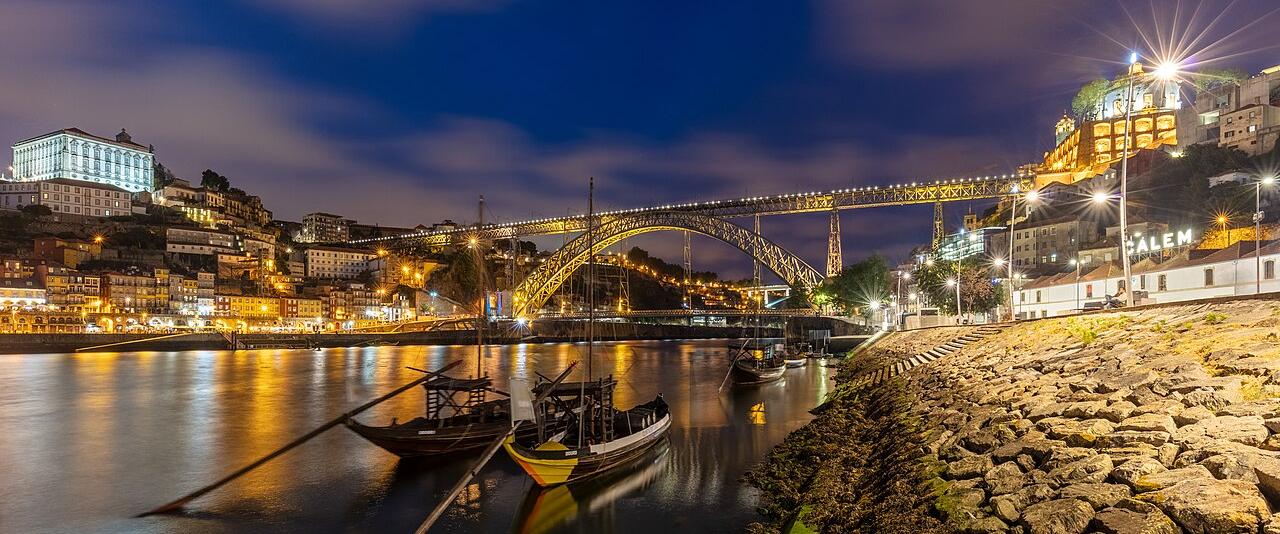
Most visitors come to Porto for three things: the river, the tiles and the port wine. All three are here, and all three have a story behind them that the postcards leave out. This is the city that, by tradition, gave a prince to the age of discovery, held out alone for a year against an army to win Portugal its constitution, and kept a king's heart as a thank-you. It is also the city where a Portuguese army captain rebuilt a Jewish community that had been hiding for four centuries.
What follows is Porto's bright side, in roughly the order it happened: the firsts it can claim, the ones it can't quite, the people who made the city proud, and the institutions it still runs. Every chapter ends with something you can go and see.
1394: A Prince, and a Plate of Tripe
Henry the Navigator, the prince who organised Portugal's first voyages down the African coast, was born in Porto on 4 March 1394, according to the royal chronicler Fernão Lopes. By tradition he was born in the old royal customs house by the river, the only royal building in the city at the time. Nobody can prove it, but the building has been called the Casa do Infante, the Prince's House, ever since.
The city's nickname comes from the same era. Porto people are called tripeiros, tripe-eaters. The legend says that in 1415, when Henry was preparing the fleet that took Ceuta in North Africa, Porto built the ships, gave all its meat to the sailors and kept only the tripe for itself. There is no document to back it, and one Portuguese encyclopaedia notes the nickname may be older. The fleet is real history; the generosity is a legend the city is happy to keep. The dish is real too: tripas à moda do Porto, tripe stewed with white beans and sausage, is still on menus across town.
 The Casa do Infante, the old royal customs house where Henry the Navigator was born, by tradition. Image: Krzysztof Golik, CC BY-SA 4.0, via Wikimedia Commons.
 Tripas à moda do Porto, the tripe-and-bean stew behind the city's nickname. Image: MariaCartas, CC BY-SA 3.0, via Wikimedia Commons.
Where to see it today: the Casa do Infante, Rua da Alfândega 10, near the Ribeira. It now houses the city's historical archive, with a model of medieval Porto and Roman remains, including a mosaic floor, found under the building. It is closed on Mondays. Henry stands on a column in the Praça do Infante Dom Henrique, a short walk uphill.
 The monument to Henry the Navigator in the square that bears his name. Image: Vitor Oliveira from Torres Vedras, PORTUGAL, CC BY-SA 2.0, via Wikimedia Commons.
1499: A Charity That Never Closed
The Santa Casa da Misericórdia do Porto was founded on 14 March 1499 to care for the sick, the poor, prisoners and abandoned children. It has never stopped. For more than five centuries it has run hospitals, homes and schools, and it is still one of the city's largest social institutions.
Its greatest treasure is a painting it commissioned around 1515–17, the Fons Vitae, the "Fountain of Life", attributed to a Flemish workshop. It shows King Manuel I, his queen and their children kneeling around a fountain filled with the blood of Christ. The Misericórdia kept it in its own headquarters on Rua das Flores for centuries.
In 1770 the Misericórdia laid the first stone of a new hospital designed by the English architect John Carr of York. The Hospital de Santo António opened in 1824, and though only about two-thirds of Carr's plan was ever built, it is still a working hospital today.
 King Manuel I in the Fons Vitae, painted around 1515–17 for the Misericórdia. Image: Attributed to Colijn de Coter, Public domain, via Wikimedia Commons.
Where to see it today:
- The Museu da Misericórdia do Porto (MMIPO), Rua das Flores 15, opened in 2015 in the old headquarters. The Fons Vitae is its centrepiece.
- The neoclassical façade of the Hospital de Santo António, near the Jardim da Cordoaria. It is a working hospital, so look from outside.
 The Hospital de Santo António, designed by John Carr of York and opened in 1824. Image: Vitor Oliveira from Torres Vedras, PORTUGAL, CC BY-SA 2.0, via Wikimedia Commons.
1756: Drawing a Line Around the Vineyards
Port wine is made from grapes grown about 100 km up the river, on the steep terraced slopes of the Douro Valley, and was shipped down to Porto to age in the lodges of Vila Nova de Gaia, across the river.
In the mid-18th century the trade was in trouble: prices had collapsed and adulterated wine was being sold as port. In 1756 the Marquis of Pombal founded a state company to control the trade, and drew an official boundary around the vineyards allowed to produce port. Only wine from inside the line could carry the name.
Portugal often calls this the world's first demarcated wine region. It isn't quite: Chianti was delimited in 1716 and Tokaj in 1737. What the Douro can fairly claim is to be one of the earliest, and among the first to combine a boundary with state regulation of the wine itself. In 2001 UNESCO listed the Alto Douro wine region as a World Heritage Site.
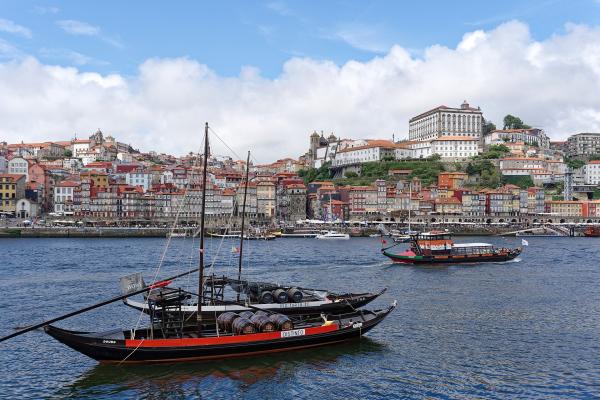
For centuries the wine came down the river in rabelos, flat-bottomed boats built to ride the Douro's rapids. The railway up the valley, opened in 1887, and later the roads ended their trade, and only a handful were still working by the 1960s.
 Terraced vineyards in the Douro Valley, inside the line drawn in 1756. Image: Grand Parc - Bordeaux, France from France, CC BY 2.0, via Wikimedia Commons.
Where to see it today: the port lodges along the riverfront at Vila Nova de Gaia, most of which offer tours and tastings. The rabelos moored in front of them belong to the port houses. On 24 June, during the São João festival, they race each other down the river.
 Rabelo boats moored at Vila Nova de Gaia, opposite the Ribeira. Image: Diego Delso, CC BY-SA 3.0, via Wikimedia Commons.
1820: Portugal's First Constitution
On 24 August 1820 a group of army officers, backed by a secret society of Porto liberals called the Sinédrio, rose up on the Campo de Santo Ovídio and demanded a constitution. The movement spread to Lisbon without a battle, elected a parliament, and produced the Constitution of 1822, Portugal's first. It replaced absolute monarchy with an elected parliament and equal rights before the law.
Where to see it today: the Praça da República, the former Campo de Santo Ovídio. In 2020, for the bicentenary, the city's assembly voted to recommend a monument there. As far as we could find, none has been built yet.
 The Praça da República, the former Campo de Santo Ovídio where the 1820 revolution began. Image: Leandro Pita, CC BY-SA 4.0, via Wikimedia Commons.
1832–1833: The Unvanquished City
Twelve years later, Portugal's two royal brothers went to war over the throne and the constitution. Pedro, the liberal, had given up the Brazilian throne to fight for his young daughter's claim; Miguel wanted to rule as an absolute king. In July 1832 Pedro landed near Porto with a small liberal army and took the city. Miguel's much larger forces surrounded it.
The siege lasted more than a year. Porto was shelled, short of food, and hit by cholera and typhus. The figures for the two armies vary wildly between sources, but Pedro's side was heavily outnumbered. The city held. In August 1833 the siege was lifted, and within a year the liberals had won the war.
Porto's reward came in 1837: Queen Maria II, Pedro's daughter, added the word Invicta, "unvanquished", to the city's titles. Its full motto, still on the coat of arms, is Antiga, Mui Nobre, Sempre Leal e Invicta: ancient, very noble, always loyal and unvanquished. Locals still call Porto a Invicta.
Pedro died in 1834, aged 35. In his will he left his heart to Porto. It arrived in 1835 and has been kept ever since in the chancel of the Igreja da Lapa, in a mausoleum whose urn needs five keys, held by the church brotherhood and the city council. It has been shown in public only once, in August 2022, before it travelled to Brazil for the bicentenary of Brazilian independence, which Pedro had declared in 1822.
 The equestrian statue of Pedro IV in Praça da Liberdade. Image: Julien Chatelain from Paris, France, CC BY-SA 2.0, via Wikimedia Commons.
Where to see it today:
- The Igreja da Lapa, Largo da Lapa, where the mausoleum stands in the chancel. The heart itself is not on view.
- The statue of Pedro IV in Praça da Liberdade, at the foot of the Avenida dos Aliados.
- The city's coat of arms, with its motto, on the Câmara Municipal at the top of the Aliados.
1877 and 1886: Two Record Bridges
Porto sits on cliffs above a deep river gorge, which made it hard to cross. Two iron bridges solved that, and both broke records.
The Maria Pia Bridge, a railway bridge opened on 4 November 1877, was built by the firm of Gustave Eiffel, though most of the design work was done by his partner Théophile Seyrig. Its 160-metre arch was the longest single-arch span in the world when it opened. Trains used it until 1991; it now stands unused, a national monument.
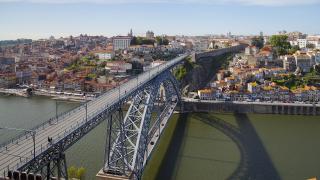
Seyrig then designed the Dom Luís I Bridge on his own. Opened in 1886, its 172-metre arch was the longest of its type in the world at the time. It has two decks: the lower one at river level, the upper one at the height of the old city walls. Since 2005 the metro has run across the top.
 The Maria Pia Bridge, opened in 1877 with the longest single arch in the world at the time. Image: Joseolgon, CC BY 4.0, via Wikimedia Commons.
Where to see it today: walk across the upper deck of the Dom Luís I Bridge, from the Batalha area to the Serra do Pilar monastery, for the best view of the city. The Maria Pia is best seen from the riverside road east of the centre, or from the upper deck of the Dom Luís looking upstream.
1905–1916: Twenty Thousand Tiles
Porto's blue-and-white tiled walls are not as old as they look. Many of the most famous were made in the early 20th century, in a revival of a Portuguese tradition going back to the 1500s.
The finest is inside São Bento station. Between 1905 and 1916 the painter Jorge Colaço covered the entrance hall with about 20,000 tiles, painted with scenes of Portuguese history: the arrival of King João I and Philippa of Lancaster in Porto, the conquest of Ceuta, and battles of the 12th century, with friezes of country life and the history of transport above them.
 The tiled entrance hall of São Bento station, painted by Jorge Colaço between 1905 and 1916. Image: John Samuel, CC BY-SA 4.0, via Wikimedia Commons.
Two churches nearby have tiled walls on the outside. The Capela das Almas on Rua de Santa Catarina was covered in 1929 with nearly 16,000 tiles showing the lives of St Francis and St Catherine; it looks 18th-century but isn't. The side wall of the Igreja do Carmo, beside the university, has a huge panel from 1912 showing the founding of the Carmelite order.
 The Capela das Almas, covered in nearly 16,000 tiles in 1929. Image: Krzysztof Golik, CC BY-SA 4.0, via Wikimedia Commons.
 The tiled side wall of the Igreja do Carmo, added in 1912. Image: John Samuel, CC BY-SA 4.0, via Wikimedia Commons.
Where to see it today: São Bento station, on Praça Almeida Garrett, open to everyone, free. The Capela das Almas, Rua de Santa Catarina 428, free. The Igreja do Carmo, beside the Praça de Gomes Teixeira.
1906: A Bookshop, and a Myth
Livraria Lello, on Rua das Carmelitas, opened in its present building on 13 January 1906. Its neo-Gothic façade, carved wooden ceilings, stained-glass skylight and crimson forked staircase make it one of the most photographed shops in Europe.
For years, guides told visitors it inspired the library at Hogwarts. J.K. Rowling lived in Porto in the early 1990s, and the story was too good to check. In May 2020 she checked it for everyone: she wrote that she had never been to the shop, had not known it existed, and that it had nothing to do with Harry Potter. The bookshop is beautiful enough without it.
So many people came to look that in 2015 the shop began charging for entry. The ticket is deducted from the price of a book.
 The staircase and stained-glass skylight of Livraria Lello. Image: Matt Kieffer from London, United Kingdom, CC BY-SA 2.0, via Wikimedia Commons.
Where to see it today: Livraria Lello, Rua das Carmelitas 144, next to the Torre dos Clérigos. Buy a timed ticket online in advance to avoid the queue.
1923–1938: The Captain Who Rebuilt a Community
In 1497 Portugal forced its Jews to convert. Many kept their faith in secret for centuries, especially in the villages of the north. Artur Carlos de Barros Basto, born in Amarante in 1887, came from such a family. An army captain and a veteran of the First World War, he formally converted to Judaism in the 1920s and set out to bring the hidden Jews of northern Portugal back into the open.
He founded the Porto Jewish community in 1923, travelled through the villages, published a newspaper and opened a school for the descendants of converts. With money from the Kadoorie family of Shanghai, the community built the Kadoorie Mekor Haim Synagogue, inaugurated in 1938. In the late 1930s and early 1940s, Barros Basto and the community helped hundreds of Jewish refugees fleeing Nazi Europe through Porto.
In 1937 the army dismissed him on charges now widely seen as antisemitic persecution; he has been called "the Portuguese Dreyfus". He died in 1961. In 2012 Portugal's parliament recommended his posthumous reinstatement in the army.
 Captain Artur Carlos de Barros Basto. Image: Bricking, Public domain, via Wikimedia Commons.
 The Kadoorie Mekor Haim Synagogue, inaugurated in 1938. Image: ComunidadeIsraelitaPorto, CC BY-SA 4.0, via Wikimedia Commons.
Where to see it today: the Kadoorie Mekor Haim Synagogue, Rua Guerra Junqueiro 340, in the Boavista area. Visits are by guided tour only, booked in advance through the Jewish community, which also runs the Jewish Museum of Porto in the same complex.
The 1990s and 2000s: The Porto School
Porto has produced two winners of the Pritzker Prize, architecture's highest honour: Álvaro Siza, in 1992, and Eduardo Souto de Moura, who worked in Siza's office as a young man, in 2011. Together with their teacher Fernando Távora they are known as the "Porto School", an architecture of white walls, careful light and close attention to place.
Siza designed the city's Faculty of Architecture and the Serralves Museum of Contemporary Art, opened in 1999 in the grounds of an Art Deco villa and its park.
 The Serralves Museum, designed by Álvaro Siza and opened in 1999. Image: Joseolgon, CC BY 4.0, via Wikimedia Commons.
In 1996 UNESCO listed Porto's historic centre as a World Heritage Site. In 2001 Porto shared the title of European Capital of Culture with Rotterdam, and commissioned a concert hall from the Dutch architect Rem Koolhaas. The Casa da Música, a white angular block on the Rotunda da Boavista, opened in April 2005, Portugal's first building designed purely for music.
 The Casa da Música, opened in 2005. Image: John Samuel, CC BY-SA 4.0, via Wikimedia Commons.
Where to see it today: the Serralves Museum and Park, Rua D. João de Castro 210. The Casa da Música runs guided tours and concerts most days. The historic centre is all around you.
2022: The Market That Came Back
The Mercado do Bolhão, Porto's central food market, had been falling apart for decades. From 2005 parts of it stood under scaffolding. Restoration finally began in 2018, and on 15 September 2022 it reopened, with its old structure restored and its traders back: about 80 stalls of fish, fruit, flowers and bread, with shops and restaurants around the edge.
 The restored Mercado do Bolhão, reopened in 2022. Image: Afsalgado, CC BY-SA 4.0, via Wikimedia Commons.
Where to see it today: the Mercado do Bolhão, Rua Formosa, in the centre. Go in the morning, when the fish stalls are busiest.
Every June: The Night of São João
On the night of 23 June, the whole city stays up for São João, the feast of St John. People grill sardines in the streets, buy pots of basil, and walk through the old town until dawn, tapping each other on the head. Once it was done with leeks; since the 1960s, when a local industrialist started making them, mostly with soft plastic hammers. At midnight fireworks go up over the river. On 24 June, a city holiday, the rabelos race on the Douro.
Where to see it today: be in Porto on 23 June. The Ribeira, Fontainhas and the riverside are the busiest spots. Hot-air paper lanterns are only allowed at certain times, when the authorities permit them.
Food Worth a Mention: The Francesinha
The francesinha, the "little Frenchwoman", is a sandwich of steak, ham and sausage under melted cheese and a hot beer-and-tomato sauce. It is usually credited to a cook at the restaurant A Regaleira in the 1950s, who adapted the French croque-monsieur, but that story is widely repeated rather than documented. It is very much a Porto dish, and best shared.
 A francesinha, Porto's heaviest contribution to world cuisine. Image: Ih8connecticut, CC0, via Wikimedia Commons.
How to See Bright Porto
A self-guided walk, about 4 km. Start at São Bento station for the tiles. Walk up to the Capela das Almas and the Mercado do Bolhão, then down the Avenida dos Aliados to the statue of Pedro IV. Continue to the Igreja do Carmo and Livraria Lello, then down Rua das Flores to the Misericórdia museum. Drop down to the Casa do Infante and the Ribeira, and finish by walking across the upper deck of the Dom Luís I Bridge to the Serra do Pilar for the view, with the port lodges of Gaia below you.
Further afield:
- The Igreja da Lapa and Pedro IV's heart.
- The Kadoorie Mekor Haim Synagogue (tour booked in advance).
- Serralves and the Casa da Música, both in the Boavista area.
- A day trip up the Douro Valley, by train from São Bento to Pinhão.
Dates to know:
- 23–24 June: São João, Porto's biggest night of the year, with the rabelo regatta on the 24th.
- 24 August: the anniversary of the 1820 revolution.
- Summer and autumn: the grape harvest in the Douro, usually from late August to early October.


.jpg)
_-_Colijn_de_Coter_(attributed).png)
.jpg)
.jpg)


.jpg)
.jpg)

.jpg)

.jpg)


